
For most founders, the pitch deck is the first real test of your fundraise. It’s the document that decides whether an investor leans in or moves on, often in the first couple of minutes. Get it right and you open the door to a conversation; get it wrong and you rarely get a second look.
This is the first volume of our Startup Fundraising Guide, where we share what we look for as investors, especially in B2B software startups. We’ll start where every raise starts: building a pitch deck for investors that actually gets you in the room.
What is a Pitch Deck and Why is it Important?
Let’s start with the basics. A pitch deck is a visual and brief presentation that provides investors with an overview of your startup. Founders use it when looking for fundraising to convey their ideas to potential investors in a concise and engaging way.
This presentation must clearly communicate the problem your startup is solving, the solution provided to solve that issue, the market opportunity, your startup’s unique value proposition, along with the traction and metrics, business model and financial projections. Other key components to include in a pitch deck are your startup’s vision, mission, goals, and team.
In the dynamic landscape of startup fundraising, pitch decks stand as the first impression to catch a potential investor’s attention, so it is important to work on it. Investors receive tons of pitch decks day to day so making a difference with yours can be your gateway to getting funded.
Before you start creating your startup’s deck, bear in mind these tips:
- Less is More. Try to reduce every topic (problem, solution, team, etc.) of your deck to a single slide. Apply Guy Kawasaki’s rule for 10/20/30 to keep your content short and sharp.
- Research. The internet has plenty of real startup pitch decks examples, have a look at them for inspiration.
- Format. Use standard files (.pdf) and a pitch deck structure like the one we propose in this article. Don’t try to reinvent the wheel!
Crafting a Winning Pitch Deck for Investors
When we say ‘winning’, we mean it. At GoHub Ventures’ portfolio we have very good examples of decks that catch venture capitalists’ eyes.
It’s important to say that the perfect pitch deck doesn’t exist, but you can follow some guidelines and investors’ advice to work out a better one than your competitors’. Here’s a widely accepted pitch deck structure you can follow when creating yours:
INTRODUCTION. It includes your startup logo / name, a short sentence stating the company’s mission, and a time reference -month / year- to put into context the following data you’ll show.
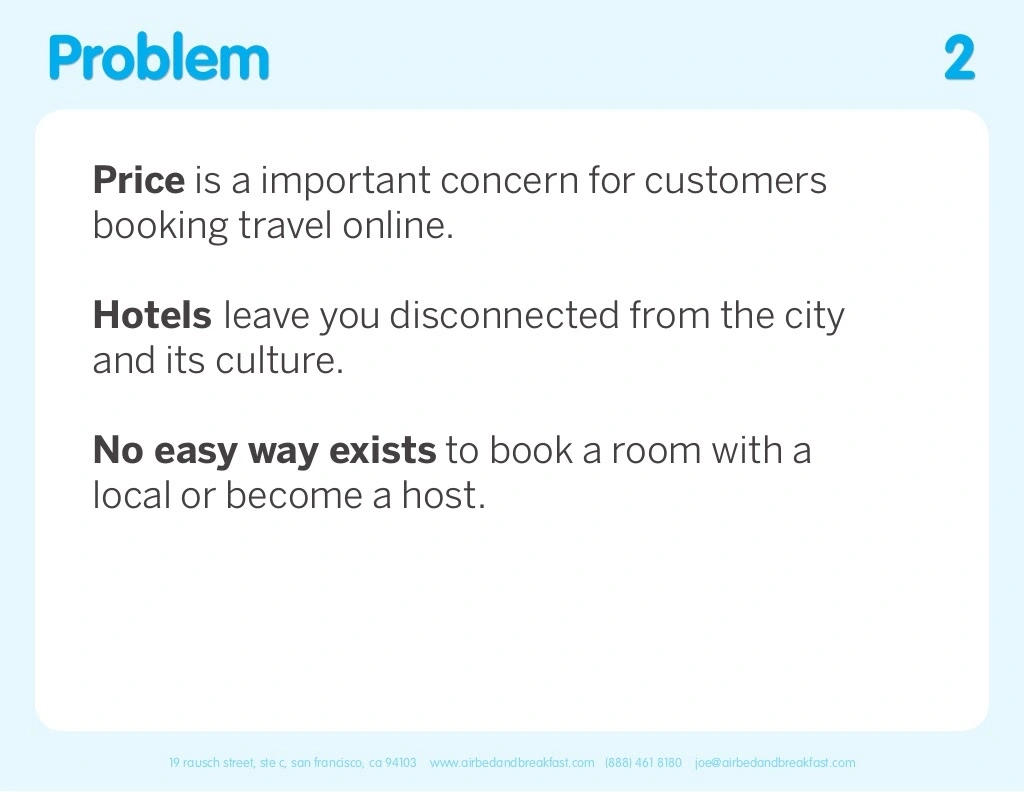
PROBLEM. Possibly the most important slide in your deck. You need to solve a real problem in order to have a mission, preferably a problem affecting a large number of people or companies; Hustle Fund explains it to perfection in this article.
SOLUTION. Many founders love to tell ‘eeeeeverything’ that their product does. Again, keep it simple and don’t show all the features you plan to build. Instead, show that secret sauce making your product unique.
MARKET. Investors are skeptical about your solution, but will pay attention when you let them know how big is the pie you intend to eat. Be clear about market size, how much you can currently reach and what percentage of that you’re certain to secure.
BUSINESS MODEL. Explain how you plan to make money on your users as clearly as possible. One of the very first decks from Airbnb stated ‘we take a 10% commission on each transaction’. No more questions!
COMPETITION. Define who your competitors are so that investors can understand similar solutions in the market and what makes you different and better from them, but keep it realistic
TEAM. Investors may fuel companies with cash, but it’s the people who manage it. So, who are you telling me is going to use my money? Prove you have a talented and dedicated team, show if any of them has worked for big tech, comes from prestigious universities or has previous success exiting a startup.
INVESTMENT. Say how much money you are looking for. If this isn’t your first round, you can show a timeline with info from previous investments.
VALUATION. What’s the price of the company for you? This helps VCs understand how much equity they’re acquiring if investing.
CONTACT. Show contact details and, perhaps, your deadline to make a decision about the investment round you’re in.
Airbnb’s original 2009 pitch deck has become a popular reference for founders. As one of the first public pitch deck releases from a unicorn company, it garnered significant media attention. Beyond its unicorn status, and 2000s aesthetic, the pitch deck remains a valuable example. It’s concise, to the point, and it follows this widely accepted structure that only requires 10 slides to impress investors.
Important Metrics from B2B Startups on Pitch Decks
Including key metrics that demonstrate your startup’s growth potential, market position and financial health is a must to convince investors. These are the most important ones that B2B startups should add to their pitch decks:
- Monthly Recurring Revenue (MRR) & Annual Recurring Revenue (ARR). These metrics indicate the consistent revenue your startup generates on a monthly and yearly basis. MRR and ARR are critical for showing revenue stability and growth potential. Highlight any trends and significant increases over time.
- Customer Acquisition Cost (CAC). CAC measures the cost of acquiring a new customer. It’s a vital metric for understanding the efficiency of your sales and marketing efforts. Provide details on how this cost has evolved and what strategies you’re implementing to optimize it.
- Customer Lifetime Value (CLTV). CLTV represents the total revenue you expect from a customer over their relationship with your company. Comparing CLTV to CAC gives investors insights into the profitability of your customer base. A high CLTV/CAC ratio is a positive indicator of long-term sustainability.
- Churn Rate. Churn rate shows the percentage of customers who stop using your product over a given period. A low churn rate indicates customer satisfaction and product-market fit. Explain any fluctuations and what measures you’re taking to reduce churn. Understanding why customers stop using your product is a plus, maybe you’ll find out how to have them coming back.
- Gross Margin. Gross margin reflects the profitability of your software by showing the percentage of revenue that exceeds the cost of goods sold (COGS). A high gross margin indicates that your business can scale efficiently.
- Net Promoter Score (NPS). Your customers’ main interaction is within your product, so you need to pulse their level of satisfaction. NPS measures customer satisfaction and loyalty by asking customers how likely they are to recommend your product to others. A high NPS suggests strong customer advocacy and can be a compelling point for investors. On a scale of 1 to 10, only 9 to 10 is considered positive NPS.
- Customer Segmentation. Software businesses typically offer different plans and memberships to several targets. Break down your customer base by segments, such as industry, company size, or geography. This provides investors with insights into your market reach and targeting strategy.
By including these metrics in your pitch deck, you provide investors with a comprehensive view of your startup’s performance and potential, increasing your chances of securing funding.
6 Common Mistakes in Pitch Decks
Pitching on a scene in front of a large audience or talking privately with investors when money for your company is on the table… can make founders nervous. That’s normal, we’re all humans. However, repeating common mistakes in your pitch deck may show a lack of preparation.
While there’s no one-size-fits-all approach, certain pitfalls can significantly reduce your chances of securing funding. Here’s six common mistakes you should avoid:
- Too long or too short. A pitch deck that drags on can bore investors, while one that’s too brief may not provide enough information. Like we wrote, aim to be as close as possible to 10 slides adhering to Guy Kawasaki’s 10/20/30 rule. This balance ensures you cover all necessary points without overwhelming your audience.
- Unprofessional appearance. While no one expects that you hire a design agency for a pitch deck, at least it should reflect the professionalism of your startup. Poor design, inconsistent branding, and cluttered slides can create a negative impression. Keep it clean, visually appealing and aligned to your brand identity. Luckily, today AI already provides high-quality graphics, consistent fonts, and color schemes to enhance readability and engagement.
- Overloaded text. Investors prefer visuals over text-heavy slides. Dense paragraphs can be off-putting and difficult to digest quickly. Use images, charts, and infographics to convey your message effectively. Visuals can illustrate your points clearly and make your presentation more engaging. The fewer words on your pitch deck, the more they’ll listen to you. That’s your chance to impress.
- Lack of competitive analysis. Failing to acknowledge your competition is a red flag for investors. It may suggest naivety or arrogance. Include a competitive analysis slide that shows you understand the market landscape and have a strategy to differentiate your product. Highlight your unique value proposition and why you stand out.
- Skipping the ‘Problem’ slide. Like we said, the problem your startup is solving is the foundation of your pitch. If this isn’t clear, investors will struggle to see the relevance of your solution. Dedicate a slide to clearly articulate the problem, backed by data or real-life examples. Make it relatable and significant. Put the best of your storytelling to explain the suffering and pain behind this problem.
- Overly optimistic numbers. While it’s essential to show potential for growth, overly optimistic financial projections can damage your credibility. Investors will scrutinize your numbers, and unrealistic forecasts can lead to skepticism about your overall plan. Present realistic, data-driven financials and be prepared to explain your assumptions.
“The problem your startup is solving is the foundation of your pitch”
My Pitch Deck is Ready, What’s Next?
A great pitch deck won’t raise the round on its own, but it earns you the meeting, and that’s the whole point at this stage. Keep it to around ten slides, lead with the problem, and let your traction do the talking.
Once your deck is ready, the next challenge is delivering it. That’s what we cover in the second volume: how to tell your story and nail the pitch in front of investors.
More from the Startup Fundraising Guide
- Startup Fundraising Guide #2: Tips and Tricks to Nail Your Pitch
- Startup Fundraising Guide #3: Effective Data Rooms for Investor Confidence & Deal Closure
- Startup Fundraising Guide #4: How to Find the Right Investors for Your Startup
- Startup Fundraising Guide #5: Why Investors Say No (and How to Avoid It)
- Startup Fundraising Guide #6: Why Do Funding Rounds Exist and How Do They Work?

