
Stablecoins have quietly become one of the most important building blocks in modern finance. Once dismissed as a crypto niche, they now move hundreds of billions of dollars every month, not in speculative trading, but in everyday payments, payroll, and cross-border transfers.
As of early 2025, the global stablecoin market has surpassed $290B in circulating supply (DefiLlama), with over $72B in annualized real-world payments flowing through these digital dollars. They’re fast, cheap, programmable, and increasingly regulated. And for corporates, that combination is game-changing.
Before we get into use cases and regulation, let’s quickly define what we mean by a stablecoin.
Stablecoins Explained: Models, Benefits, and Market Growth
A stablecoin is a type of cryptocurrency designed to maintain a predictable value, usually by pegging 1:1 to a reserve asset like the US dollar. They are stable in value, backed by reserves in cash or other assets. They are blockchain-native, which means transfers clear and settle within minutes, 24/7. And because they are globally accessible, they can work anywhere there is internet access. Think of it as a digital dollar: as easy to send as an email, but without the delays, costs, and limitations of traditional bank transfers.
Main Models of Stablecoins
- Fiat-backed: Each token backed by reserves in bank accounts (e.g., USDC).
- Crypto-collateralized: Backed by excess cryptocurrency reserves (e.g., DAI).
- Algorithmic: Supply adjusts via smart contracts and market incentives (riskier).
Why the Market Is Paying Attention
The numbers tell the story:
- $290B+ in circulating supply worldwide.
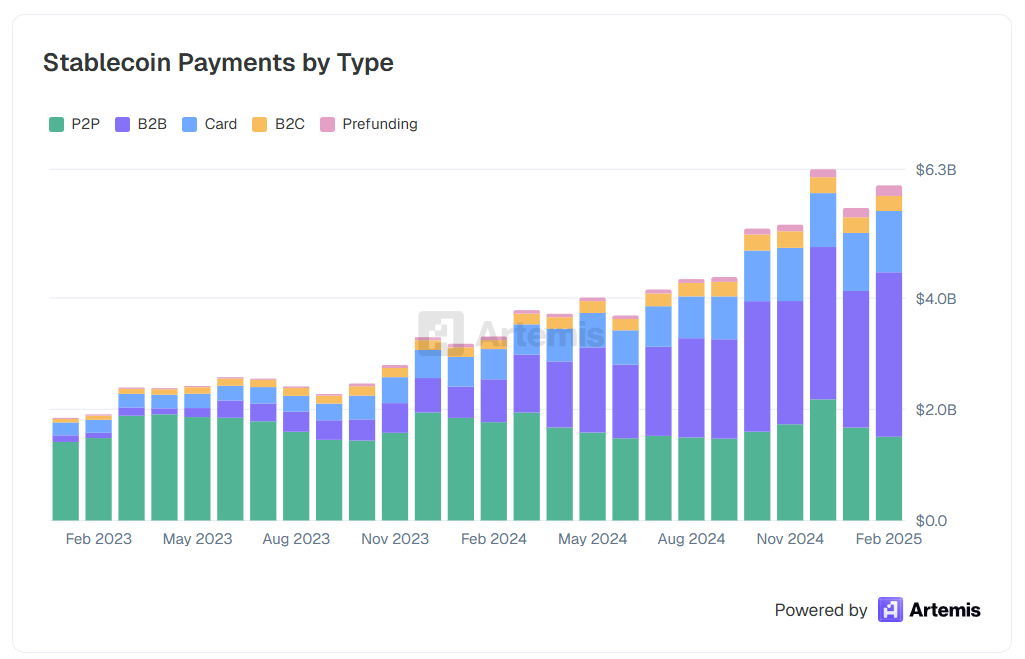
- B2B payments lead usage with $36B annualized volume, followed by P2P ($18B) and card payments ($13.2B).
- Dominated by USDT and USDC, together holding nearly 90% of the market.
Stablecoins aren’t just scaling; they’re becoming embedded in global payment corridors, especially where banking infrastructure is slow, expensive, or unreliable.
Real-World Use Cases of Stablecoin Payments
While the technology is complex, the benefits are simple: faster, cheaper, programmable payments. For businesses, stablecoin payments are already replacing slow, costly bank rails across three main areas:
Cross-Border Payments
Traditional rails can take up to five days and cost 1–3% in fees and FX spreads. Stablecoins cut that to minutes and near-zero cost.
- EU → Africa: In Nigeria, Ghana, and Kenya, stablecoins help businesses access USD liquidity despite local currency restrictions, enabling faster supplier settlement.
- EU → LATAM: Companies like Depa enable euro-to-USDC or USDT payments to suppliers and employees in Latin America, where they’re also used to hedge against inflation in markets like Argentina and Brazil. Depa connects fiat and stablecoin rails across 200+ countries, processing more than 14,000 payments a day and over $1 billion in annual volume.
Corporate Treasury
Enterprises are increasingly adopting stablecoins for treasury operations. They allow companies to pay vendors instantly, move funds between subsidiaries without SWIFT delays, or maintain dollar treasuries in volatile FX environments. From Ferrari to SpaceX, big names are quietly adopting stablecoins for treasury efficiency (BCG Stablecoins Report 2025), while networks like Ripple and Circle Payments Network are building programmable alternatives to SWIFT.
Regulation on Stablecoins: Clarity Is Coming
Stablecoins’ rise hasn’t gone unnoticed by policymakers. Two frameworks are leading the way in 2025:
- MiCA (EU): Covers stablecoins, utility tokens, and asset-referenced tokens. Requires 1:1 reserves, public disclosures, and EU-wide licensing.
- GENIUS Act (U.S.): Focuses exclusively on USD-pegged stablecoins, issued only by regulated financial institutions, with strict reserve and compliance rules.
Both aim to reduce systemic risk and build trust, but their scope and implementation reflect different strategic visions.
| Category | MiCA (EU) | GENIUS Act (U.S.) |
| Breadth | Covers multiple crypto-asset types | USD-pegged stablecoins only |
| Oversight | ESMA + national regulators | U.S. Treasury + federal agencies |
| Transparency | Public whitepapers + disclosures | Internal compliance + reserve audits |
| Impact | Boosts EU investor trust | Institutional legitimacy, narrower scope |
The Bigger Picture and a Maturing Ecosystem
Stablecoins are no longer “crypto tools”, they’re payment infrastructure. For corporates, they offer:
- Cost reduction in cross-border flows.
- Operational speed and flexibility.
- Programmable treasury and settlement workflows.
And global adoption is accelerating. Over 10% of U.S.–Mexico remittances now flow via stablecoins. Payments giants like Visa, PayPal, and Stripe are integrating stablecoin rails, and M&A activity is heating up, from Visa’s investment in BVNK to Ripple’s $4–5B bid for Circle.
To understand just how broad and mature the stablecoin ecosystem has become, consider this snapshot of key players in 2025:
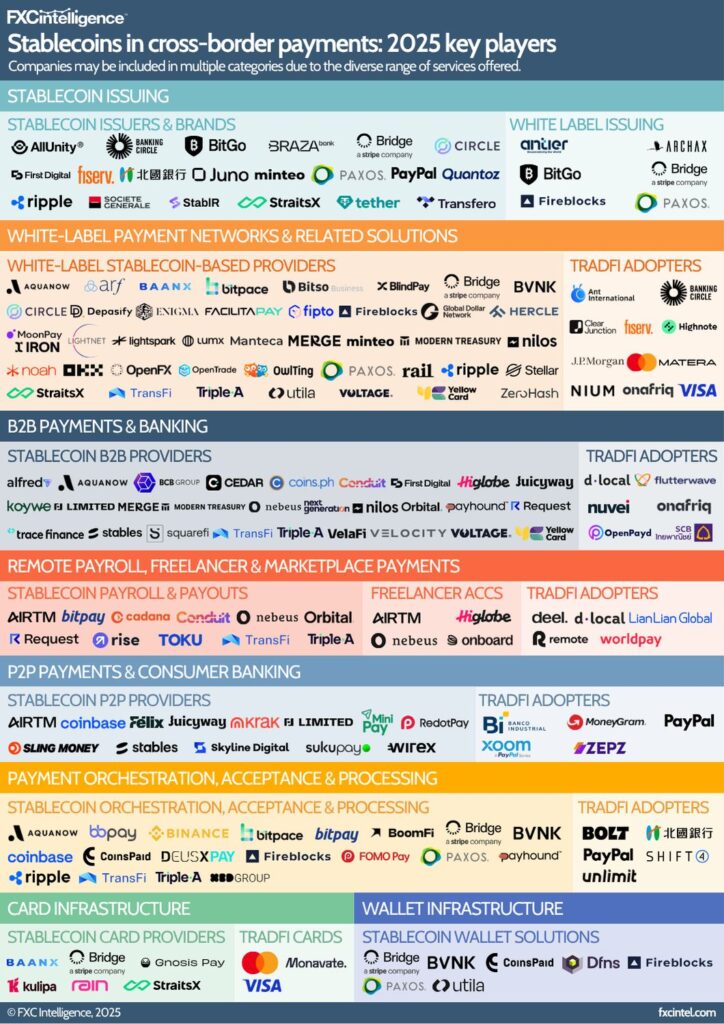
This map highlights how stablecoins are no longer niche; they’re now part of an extensive network of issuers, payment processors, infrastructure providers, and traditional financial adopters across every layer of the value chain.
Final Thoughts
The combination of scale, regulation, and enterprise adoption means stablecoins are poised to become the next-generation global payment rails.
For corporate leaders, the question is no longer if this will impact your operations, it’s when. Those who explore use cases now will be better positioned as this new infrastructure becomes the norm.
This article is part of Depa‘s collaboration with GoHub Ventures, one of our earliest investors and biggest believers in our vision for the future of digital assets.
For feedback or further information please contact: perez@depa.finance