
Healthcare AI has moved beyond pilot projects and proof-of-concept experimentation into a phase defined by real-world implementation. Hospitals and health systems are now focused on integrating AI into clinical workflows while meeting strict requirements around governance, compliance, and accountability, which makes deployment significantly more complex than early enthusiasm suggested.
In this context, the primary bottleneck is not the sophistication of the algorithm but the condition of the underlying data. Fragmented laboratory systems, inconsistent reporting formats, and incompatible reference ranges create structural barriers that make scalable and trustworthy AI deployment difficult to achieve.
OpenHealth operates precisely at this intersection. We spoke with its co-founder and CEO, Gerrit Glass, to understand his perspective on the evolving role of AI in healthcare and why harmonizing health data is an essential condition for responsible implementation.
Fragmented Health Data as a Structural Barrier to AI
Artificial intelligence in healthcare depends on structured, reliable, and comparable data. Yet across hospitals and laboratories, medical information is stored in incompatible formats, measured in different units, and interpreted using varying reference ranges. Unlike banking or other digital industries where interoperability is standard, healthcare remains deeply fragmented.
As Gerrit explains: “In healthcare, you can measure everything, from lab diagnostics to behavior data, but every system does it differently.”
This lack of standardization creates more than operational inefficiency. It directly limits AI adoption in healthcare. Algorithms trained on inconsistent datasets struggle to generalize across institutions, while deployment becomes risky when underlying data cannot be trusted or compared. In some hospitals, information is still faxed or manually transferred, highlighting how far parts of the system remain from true interoperability.
Without harmonized health data, AI cannot scale safely or effectively. Fragmentation is not just a technical inconvenience; it is a structural barrier to implementation.
A Harmonized Health Data Infrastructure as a Solution
OpenHealth addresses this barrier by starting where the impact is greatest: laboratory and diagnostic data. Around 70% of all medical decisions depend on lab results, yet these datasets remain among the hardest to unify.
“Even within the same hospital network, two labs can have completely different structures for the same tests,” Gerrit notes.
By building infrastructure that reconciles units, aligns reference ranges, and standardizes terminology, OpenHealth transforms fragmented and heterogeneous lab data into a semantically harmonized structure of biomarkers that can be reliably used across institutions. This enables longitudinal integrity, scalable integration, and clinically meaningful interpretation across diverse data sources.
“The more structured and accessible the data, the easier it is to move from reactive to preventive healthcare,” Gerrit adds.
Once standardized, laboratory data becomes a stable foundation for AI applications, from improving clinical workflows to enabling longitudinal biomarker tracking. As highlighted in the State of Health AI 2026 by Bessemer Venture Partners, the AI era is creating new demand for healthcare-specific data infrastructure from AI model developers and application companies. This reinforces why harmonizing health data is becoming foundational not only for hospitals, but for the broader ecosystem building AI-native healthcare solutions.
Enabling Scalable AI Implementation Through Harmonized Infrastructure
If fragmented data is the structural barrier to AI adoption, then harmonizing health data becomes the critical enabler for real-world deployment. In healthcare, AI cannot operate reliably unless the underlying datasets are consistent, comparable, and clinically validated across systems.
OpenHealth is building precisely this infrastructure layer. Its platform is not simply a data formatting tool but the backbone of a more interoperable healthcare ecosystem, designed to ensure that AI systems are trained and deployed on medically meaningful information rather than inconsistent records.
By reconciling discrepancies in laboratory measurements and document formats, the company enables healthcare organizations to use data consistently across clinical contexts. This depth of harmonization ensures that AI outputs are grounded in standardized inputs, reducing operational risk and improving reliability.
From Infrastructure to Real-World Deployment
The impact of harmonizing health data becomes visible in implementation. OpenHealth collaborates with hospitals to create centralized data lakes across multiple sites, allowing medical teams to analyze trends at scale, benchmark performance, and improve operational efficiency.
Beyond hospitals, OpenHealth also works with large laboratory groups, insurance companies, and Lab Information System (LIS) providers, enabling all stakeholders to operate on a unified and harmonized data structure that reduces fragmentation across the ecosystem.
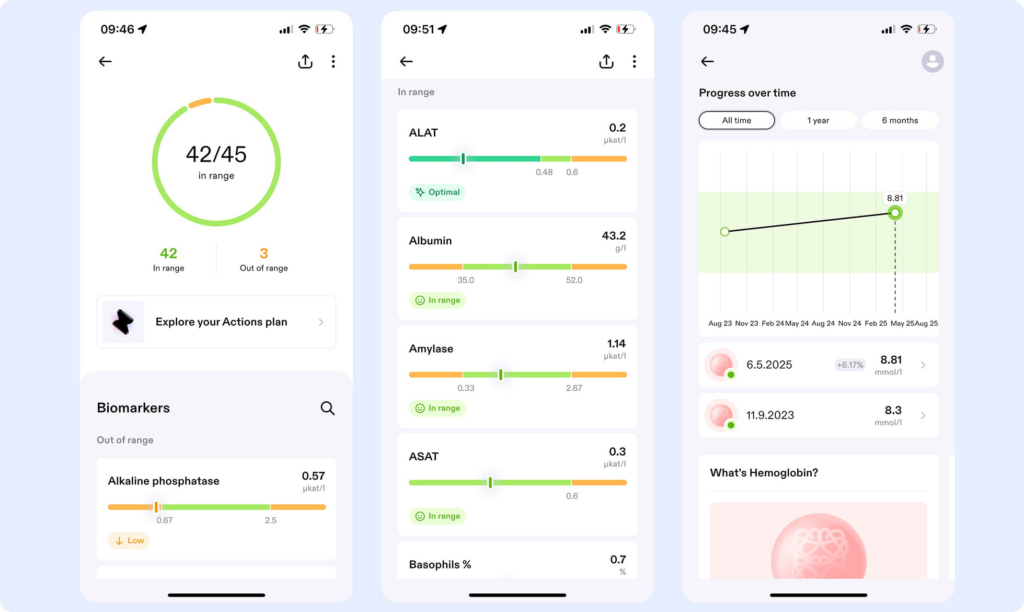
The same infrastructure supports wellness platforms and gym networks, enabling individuals to track key biomarkers such as vitamin levels, hormones, and metabolic indicators over time. Longitudinal consistency is what makes this tracking actionable rather than anecdotal.
Healthtech startups also build on top of this harmonized layer. Through OpenHealth’s APIs, they develop AI models for diagnostics, treatment recommendations, and preventive risk analysis. By focusing on data accessibility rather than owning the end-user application, OpenHealth positions itself as an enabler of the AI healthcare ecosystem, empowering other innovators to move faster while relying on structured, validated data.
Toward Preventive and Personalized Healthcare
For Gerrit, harmonizing health data is not an end in itself. Infrastructure matters because of what it enables. “It’s not just about biohacking or optimization,” he says. “From both a lifestyle and financial perspective, prevention is always better than reaction. The earlier you can detect risks, the more you can act.”
When laboratory data is structured, standardized, and longitudinally comparable, healthcare begins to shift from episodic intervention to continuous insight. Biomarkers can be tracked over time with consistency, allowing AI systems to detect patterns and surface risks earlier than traditional care models allow.
By making diagnostic information interoperable and medically meaningful, OpenHealth enables the integration of clinical records, behavioral signals, and, in the future, genetic data into a more complete view of human health. That foundation makes it possible to personalize treatment pathways, anticipate potential conditions before they escalate, and move from reactive medicine to proactive care.
The future of healthcare will not be defined solely by artificial intelligence, but by the quality and continuity of the data that feeds it. Harmonizing health data is what turns AI from a tool into a system capable of supporting preventive and personalized medicine at scale.

