
Wealth management is undergoing a structural shift toward AI-native operating models, and Sherpas is building the operating layer that enables this transition. Our conviction is grounded in two things. First, a relationship with the team built over more than two years, during which they consistently impressed us with their judgment, pace of execution, and ability to learn and iterate. Second, strong market pull and accelerating urgency around AI adoption in advisory workflows.
Sherpas’ $3.2M seed round was led by 1248, the family office of Marty Bicknell, founder and CEO of Mariner Wealth Advisors. The round also included participation from AUA Capital Management, GoHub Ventures, and strategic investors from across the advisory industry, and Steve Lockshin (Vanilla, AdvicePeriod) joined the Board. This is a strong signal that sector experts agree: the next decade will be defined by whether advisory firms modernize their operating layer to fully integrate AI in wealth management, not by adding another tool to the stack.
The Market Is Moving Fast and the Urgency Is Now Visible
For years, AI in wealth management was discussed as an enhancement, a feature, or a productivity add-on. Recently, that framing changed in a very public way.
At the beginning of February 2026, Altruist announced AI-powered tax planning inside its Hazel platform, claiming it can generate personalized tax strategies in minutes by interpreting tax returns and a wide range of client documentation and data sources. The market reaction was immediate. Reports highlighted a selloff across publicly traded wealth and brokerage firms, driven by investor concern that automated advice and AI-driven workflows could compress economics and disrupt incumbents.
The key takeaway is not that one new product wins. It is that the market is now pricing in a fundamental shift: AI is becoming infrastructure. Advisory firms are moving from experimenting with AI to rebuilding core workflows around it.
The Underlying Problem: Advice Production Is Still a Manual, Fragmented Operating System
Wealth management is under pressure from multiple directions. Client expectations are rising, especially around speed, personalization, and clarity. Planning complexity continues to grow across tax, retirement, risk, and multi-account portfolios. Advisors and para-planners remain burdened by manual analysis and process-heavy plan preparation.
Despite modern software stacks, much of the industry still relies on fragmented point solutions and time-intensive and manual workflows that take days. This creates hidden variability across advisors and teams, and overall limits scalability.
Sherpas’ view is that the bottleneck is not advisor judgment; it is the analytical burden and the absence of a standardized operating layer capable of supporting enterprise-grade AI-powered advisory workflows.
Sherpas: The AI-Native Operating Layer for Financial Advice
The company is not positioning itself as another planning application layer on top of legacy systems. It is building an AI-native operating layer that runs through the advice workflow end to end, from investor intake to scenario modeling to recommendation drafting.
The objective is not to replace advisor judgment, but to amplify it. Its value proposition is clear:
- Turn investor data into structured, explainable insights in minutes rather than days.
- Standardize the analytical foundation of a plan and proposal, so rigor and clarity are consistent.
- Free up advisors to focus on strategy, relationships, and high-conviction decision-making.
- Shorten time to proposal and increase conversion.
Speed as a Structural Advantage: The Time-to-Proposal Lever
In wealth management, speed is not just an efficiency metric; it is a conversion lever. The faster an advisor can turn client inputs into a clear, compliant, and explainable proposal, the higher the close rate and the better the client experience.
At the same time, many RIA (Registered Investment Advisor) are moving down-market to serve a broader client base, but legacy processes make smaller accounts hard to serve profitably. Sherpas enables that shift by compressing analysis and proposal generation from days to minutes, allowing firms to scale without adding headcount.
The solution has already been evaluated in enterprise contexts, deployed into real workflows under compliance and operations oversight. In wealth management, trust cycles are long. Artificial intelligence that is not explainable or controllable does not pass internal filters.
Team: Conviction Built Over Relationship
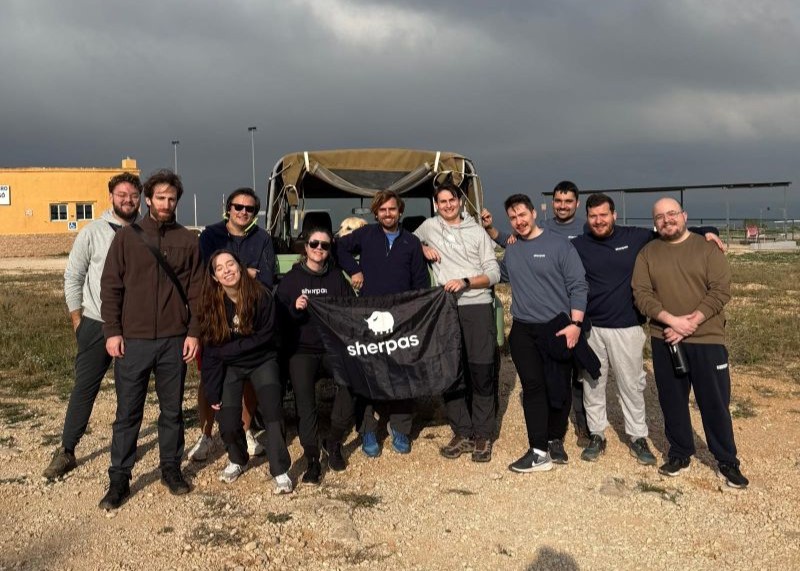
This was not a “momentum round” decision for us. We’ve known the team for more than two years, and our conviction grew through repeated interactions rather than a single pitch.
Over time, what stood out was consistency: clear thinking in a space that attracts hype; strong product instincts with an experienced, enterprise-grade mindset; high pace of execution combined with pragmatic iteration; and integrity in communication, especially when navigating uncertainty.
When markets shift quickly, the teams that win are not the ones with the most polished narrative. They are the ones with the strongest execution system and learning velocity. This founding team has repeatedly demonstrated both.
Why Sherpas Can Be a Category-Defining Company
Our decision is anchored in a clear market direction and clear product positioning. The category is forming around AI-native infrastructure. The February market reaction to new AI capabilities in advisory workflows made this even more visible. AI in wealth management is becoming structural.
The wedge is strong, and the expansion path is logical. Sherpas is deepening decision frameworks across retirement, tax, investment, and risk planning, expanding integrations with enterprise systems used by advisory practices. This is the natural path to become the underlying system that drives consistent advice production at scale.
Defensibility comes from workflow integration and compound learning. Sherpas describes a feedback loop where each engagement strengthens the system’s understanding of how advisors refine and apply recommendations, building institutional knowledge over time.
The wealth management market is sending unusually clear signals. AI is moving from experimentation to infrastructure, and the urgency is rising. Sherpas is positioned at the center of this transition. By building the AI-native operating layer that standardizes advice production, increases speed and consistency, and elevates advisor judgment, Sherpas has the potential to become foundational infrastructure in AI in wealth management.

