
Most founders don’t lose a funding round because of a weak idea, but because they unintentionally introduce doubt. Investors are constantly assessing risk, and even strong startups can lose momentum when something feels unclear, inconsistent, or simply hard to believe.
Understanding the fundraising mistakes startups should avoid is key to building investor confidence. Venture capital is a pattern-recognition business and, when something feels off, investors notice.
As part of our Startup Fundraising Guide, we look at some of the most common reasons investors say no, and how founders can avoid them.
Unbalanced Teams
Few things create hesitation faster than an unbalanced founding team. If one co-founder is still consulting, keeping a corporate job, or operating in a part-time capacity, investors quickly start questioning commitment and focus.
Early-stage companies demand intensity and speed, so any ambiguity around a founder’s availability can quickly signal hesitation. Even if there is a temporary transition period, it needs to be explained clearly and proactively. Investors must feel that the founding team is fully aligned, fully committed, and operating with complete focus on the outcome.
For tech-driven startups, the absence of a technical co-founder or fully delegating the technical side to third parties can further amplify these concerns, as it suggests limited internal ownership of the company’s core asset.
Saying You Have No Competition
Claiming you have no competition almost always weakens your credibility. Every meaningful problem already has alternatives, whether direct competitors, internal workflows, spreadsheets, or outdated software.
When founders say there is no competition, it often suggests either limited market research or a market too small to attract serious players. A stronger answer is to acknowledge the landscape and explain clearly how your company is positioned within it.
Credibility increases when founders demonstrate a clear understanding of the competitive landscape: who is operating in the space, what they do well, where they fall short, and why their own approach is meaningfully different. Investors want to see informed comparison, not dismissal.
When Market Size Turns Into a Red Flag
“If we capture 1% of this $10B market…”
VCs hear this all the time, and it rarely strengthens the case. Venture capital doesn’t fund percentage math; it funds credible expansion strategies.
Quoting a massive market size isn’t enough. What matters is where you start, why you can win that initial segment, and how you expand from there. Without a clear entry point and path to scale, large market numbers tend to feel theoretical rather than investable.
At the same time, the opposite problem can be just as limiting. Even the strongest product will struggle to attract venture capital if the underlying market is too small to generate outsized returns. Investors need both: a market that is large and growing enough to support scale, and a realistic plan to capture it.
Raising Without a Clear Plan
Saying you are raising to “accelerate growth” is not a strategy. Investors expect clarity on how the capital will be deployed and what outcomes it should drive. Hiring plans, go-to-market expansion, product development, and clear performance targets should connect directly to the size of the round.
Capital is fuel, but without a clear plan, it becomes wasted potential. Clarity on how it will be used is what gives investors the confidence to commit. This is one of the most common fundraising mistakes founders make, and one that quickly reduces investor confidence.
Can’t Explain It Clearly
If what you are building can’t be explained clearly, investors will struggle to engage. They do not need a technical deep dive to understand what you do; they need a simple, sharp explanation of what problem you solve, who it’s for, and why it matters.
Long, overly technical explanations make things harder to follow. If someone outside your space can’t understand what you do in two or three sentences, your message isn’t clear enough.
At the same time, simplicity should be backed by depth: founders must demonstrate that they truly understand the problem they are addressing, the pain points, who it involves, and how the current process actually works. Clear and concise doesn’t mean superficial; it means you’ve thought deeply enough to explain it plainly.
Poorly Prepared Deck
Your deck is more than slides; it reflects how you think and how you operate. A confusing structure, cluttered slides, unclear messaging, outdated content, or weak visual presentation can quickly undermine your credibility.
Investors see hundreds of decks. The ones that stand out are clear, thoughtful, and intentional. A well-prepared presentation feels deliberate: easy to follow, visually clean, and detailed where it needs to be. That level of care builds confidence before the conversation even begins.
Early Equity Dilution
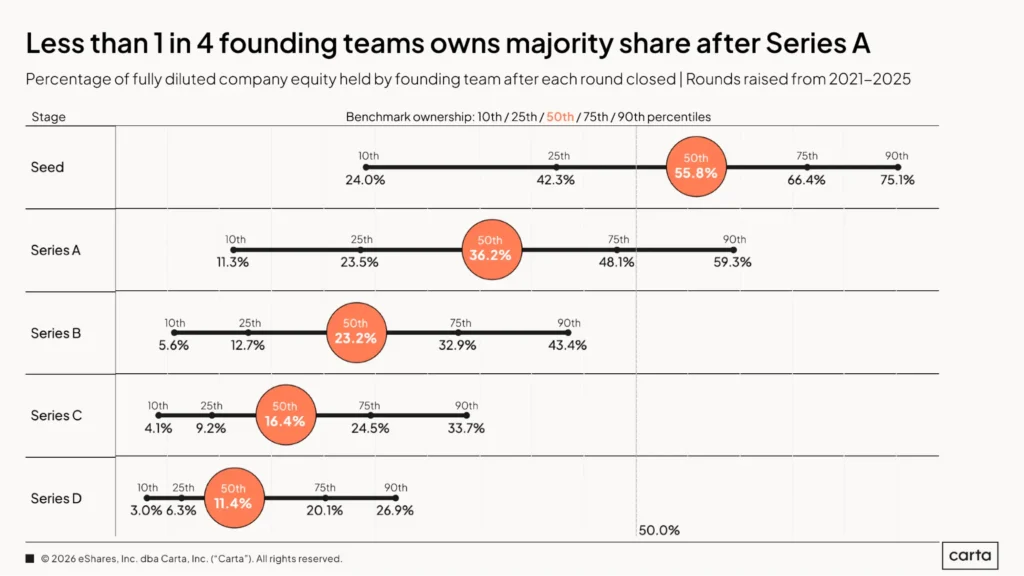
A messy cap table can quietly complicate a deal. At pre-seed stage, founders should aim to retain as much equity as possible, ideally giving away no more than 10-15% in total. By the time a startup reaches seed, cumulative dilution should generally stay under 20-25%, leaving enough room for a Series A investor to take a meaningful stake, typically 15-25%, without leaving founders or future hires with insufficient ownership.
Giving away too much too early creates problems in multiple directions. Investors may question whether founders remain sufficiently incentivized to stay the course. Future investors will look at the cap table and ask whether there is room for them, and whether the math works for subsequent rounds. And fixing an over-diluted cap table later is a conversation almost nobody wants to have.
The most common traps are multiple SAFE rounds at different valuations where the math compounds unexpectedly, rolling closes where equity accumulates investor by investor, and pre-money versus post-money confusion. The fix is simple: track every change in real time, use standard instruments, and plan your dilution roadmap backwards from your Series A before you start raising.
Past Investors Not Investing in New Rounds
Insider participation is generally seen as positive signaling. When existing investors choose to reinvest, it reflects continued conviction and strengthens the overall perception of the round.
If they don’t participate, it does not necessarily signal a problem with the startup. There can be internal reasons on the fund’s side, such as investment thesis misalignment or follow-on allocation, which may have little to do with company performance. In those situations, founders should address it directly and explain the context clearly. Reinvestment is a positive signal, but its absence is not automatically a negative one. What matters is how clearly founders handle the narrative, as uncertainty around this point can quickly influence investor perception during fundraising.
Fundraising Is About Building Conviction
Fundraising is a process of building conviction. Most investment decisions don’t fall apart because of a single major mistake; they stall because small uncertainties accumulate until the risk-reward balance tips. A weak signal here, a vague answer there, and conviction fades.
Venture investors are constantly assessing risk. They rely on pattern recognition, scanning for signals that confirm or challenge what they have seen before. The founders who succeed are not the ones who eliminate every risk, but the ones who make belief easy.
More from the Startup Fundraising Guide
- Startup Fundraising Guide #1: How to Craft a Winning Pitch Deck for Investors
- Startup Fundraising Guide #2: Tips and Tricks to Nail Your Pitch
- Startup Fundraising Guide #3: Effective Data Rooms for Investor Confidence & Deal Closure
- Startup Fundraising Guide #4: How to Find the Right Investors for Your Startup
- Startup Fundraising Guide #6: Why Do Funding Rounds Exist and How Do They Work?

