
The numbers coming out of digital health funding in H1 2026 are hard to ignore. US digital health startups raised $4 billion across 110 deals in Q1 2026 alone, the strongest opening quarter since the pandemic peak, a full billion dollars ahead of the same period last year. Europe held its own at $1.16 billion across 66 deals, with its own cluster of meaningful rounds in obesity management, insurance, dental AI, and practice software.
However, 61% of all capital in Q1 flowed to just 19 companies, including some mega-deals that stand out such as WHOOP’s $575M Series G, OpenEvidence’s $250M Series D, and Talkiatry’s $210M Series D.
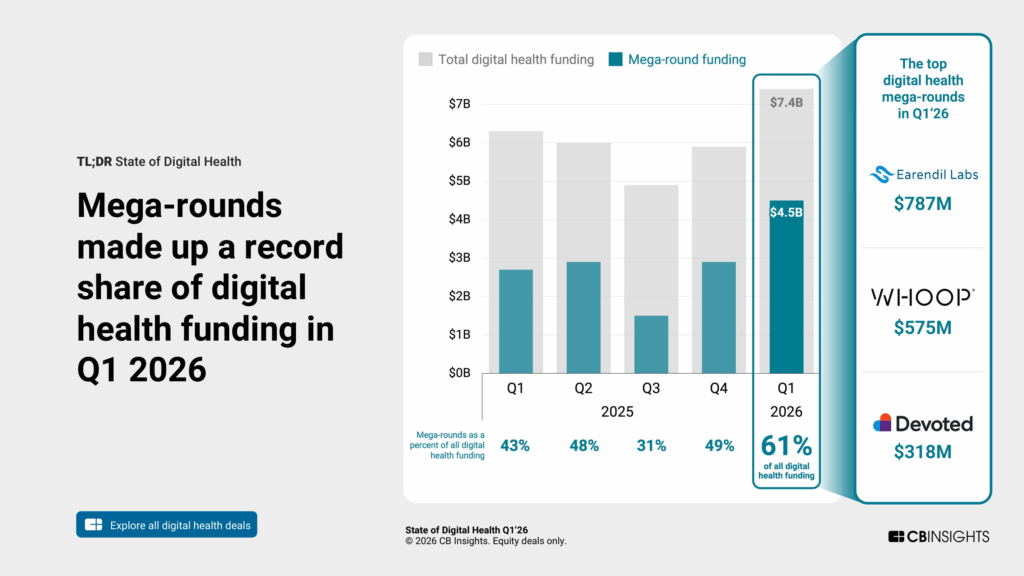
Q2 2026 data won’t close fully until July, but deal flow tracked through early June confirms the pace has held. The signal, combined, is consistent: investors are writing serious checks for a very specific type of company. Clinical infrastructure with measurable outcomes and embedded in workflows.
Here is where that capital is concentrating, and where we see the European opportunity.
Behavioral and Mental Health
Mental health attracted more capital than any other therapeutic area in the US during the start of the year, with $1.27 billion across 14 deals. Some standout rounds include Talkiatry at $210M, Grow Therapy at $150M, Ease Health at $41M, and Jimini Health at $17M.
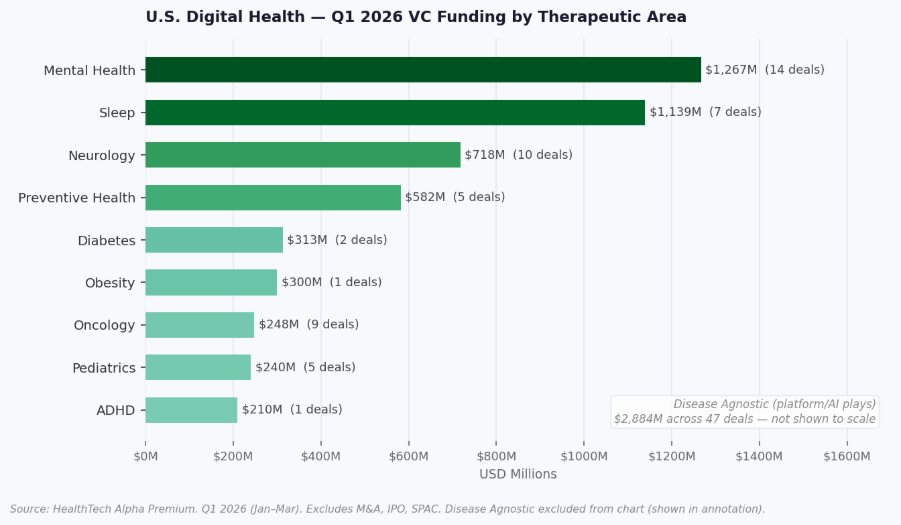
In Europe, Nyra Health in Austria closed €20M for its neurological therapy app, and Big Health raised $23.7M in February for digital therapeutics, according to Fierce Healthcare’s fundraising tracker.
Demand for mental health care in Europe continues to outpace available capacity, with psychiatric wait times in Spain, the UK, and Germany often stretching into months or even years. Employer mental health benefits have risen from 42% of US employers in 2019 to 73% today.
However, while mental health funding is on the rise, the distribution of that capital is concentrating on clinical infrastructure: psychiatry copilots, AI scribes, hybrid clinician-AI platforms, and payer-aligned workflows. What does not seem to be attracting as much capital are consumer apps, generic chatbots, and pure voice-biomarker diagnostics. The failure of Kintsugi, which raised roughly $28M for voice-based depression screening before shutting down in 2026, is now cited in nearly every founder-investor meeting in the space.
Our opinion for European startups is that the playbook has to be built from the clinician side rather than the patient side. If the product cannot produce a measurable health outcome tied to a paying channel, whether that is a payer, employer, or provider system, it is a feature.
Clinical Decision Support
Clinical decision support has been another consistent magnet for capital in H1 2026. Qualified Health closed $125M for AI-assisted clinical decision-making; OpenEvidence closed a $250M Series D; Vista AI raised $29.5M for AI-guided MRI reading; and Prenosis closed $20M for diagnostics in acute care.
The value is quantifiable, and the buyer (hospital, specialist clinic, insurer) has budget and urgency. Cutting a false negative in oncology or accelerating a radiology read is not discretionary spend. But the regulatory path for AI clinical tools in Europe is genuinely complex right now. The parallel application of the EU AI Act and the MDR/IVDR, which MedTech Europe has called an unnecessary layer of complexity, adds 18 to 24 months to certification timelines for any software classified above Class IIa. The European Commission committed €63.2M in April for AI innovation in health and is building the Cancer Image Europe infrastructure, targeting access to 60 million oncology images by the end of 2026.
What we see is that for a pre-seed company, regulatory strategy is as consequential as product strategy from day one. Similarly, proper data access agreements are key, as a company built on top of structured hospital data starts with a training advantage that is genuinely hard to replicate.
Surgical and Procedural AI
Surgical and procedural AI attracted some of the largest rounds: Apella raised $80M for AI tools to improve surgical outcomes, Hypervision Surgical closed £17M for hyperspectral imaging in the operating theatre, and SquareMind raised $18M for robotic dermatology. The rationale we see is that hospital buyers have capital budgets, the value per procedure is high, and the regulatory and technical barriers create a natural moat. CMR Surgical in the UK has raised over £350M and is still in scaling mode.
Pure surgical AI carries a return horizon of 8-12 years at minimum. The more interesting angle that we are seeing at GoHub Ventures is the software envelope around the surgical act: automated documentation, workflow intelligence, pre-op planning, and post-procedure analytics. UK-based Uncovr is a prime example of this, as they just raised $7M led by Index Ventures to automate post-operative documentation and workflow intelligence for surgeons, focusing not only on the procedure itself but on everything around it.
Vertical Practice Management
If there is one area where the European market is most systematically underbuilt, it is vertical practice management software. Splose raised $32M for practice management in allied health; HeyDonto AI closed $20M for dental EHR integration; Semble raised £30M for its open interoperable clinical platform; and TurnUp raised €2M for an intelligent no-show reduction system for dental and medical practices.
Private clinics in Europe have operated for years on generic software, spreadsheets, or legacy systems, meaning the switching cost is often low because the existing pain points are significant. The unit economics are attractive: low churn, natural expansion within a practice, and a proprietary clinical dataset that compounds in value over time.
The principal risk is European market fragmentation with different requirements across markets. We believe the winning strategy is to choose a specialty where cross-border variation is lower, and design for export from the first line of code. This is where our current deal pipeline is most active. The companies we are tracking in this space share a common architecture as they start with the practice workflow problem, add AI-assisted documentation, scheduling or RCM and build a proprietary data layer that becomes the moat. The question here is whether to build a pure AI-native product or an AI-driven BPO play that serves a recurring service model. This is something we are actively building our thesis on.
Admin AI and Revenue Cycle Management
Administrative AI and Revenue Cycle Management emerged as one of the most active funding categories of the past year. Forus closed $123M for prior authorization and pharmacy coordination; Alaffia Health raised $55M for AI claims review; Anterior closed $40M for AI insurance approvals; Amperos raised $16M for denial management. The business case in the US is undeniable, with administrative friction costing an estimated $250 to 500 billion annually and every company that compresses it finding a large, well-capitalized buyer. But prior authorization, claims management, and denial handling are consequences of the American multi-payer insurance model that simply do not exist in the same way in Europe.
In most European countries, the public system acts as dominant or sole payer, which means the friction is different. The companies succeeding in Europe in this space, like Tucuvi, which raised $20M for phone consultation automation, have done the work of translating the underlying logic to the actual friction points of the European system, rather than copying the US playbook and discovering the mismatch at pilot stage.
Drug Discovery and Pharma AI
Some of the largest rounds of 2026 are in drug discovery and pharma AI. Earendil Labs raised $787M for a deep learning platform; Isomorphic Labs closed $600M; Takeda committed up to $1.7 billion to Iambic Therapeutics. At earlier stages, Triomics raised $22M for patient matching to clinical trials, and Boltz raised $28M for open-source biomolecular design models; Perceptic raised $12M Seed led by Accel.
The space where we see early-stage logic is in patient matching for trials, real-world evidence tooling, and data infrastructure that helps pharma and CRO clients extract cleaner signals from existing data.
Our Digital Health Funding Outlook for H2 2026
Going into H2 2026, our investment thesis in digital health concentrates on five areas: vertical software for specific clinical specialties in the European private market; AI-assisted diagnostics; behavioral health infrastructure; preventive and early detection companies building from the payer side; and administrative automation correctly adapted to European system dynamics.
If you are building in any of these spaces, we would love to meet you. Tell us about your startup at gohub.vc/apply

