
In today’s startup landscape, founders are increasingly adopting “seed-strapping”: raising an initial Seed round to kickstart commercial operations and then focusing on revenue-driven growth, deliberately avoiding subsequent funding rounds like Series A. This approach offers a balanced alternative to the extremes of bootstrapping and aggressive VC-backed scaling.

Why Seed-Strapping Is Gaining Momentum
Several factors contribute to the rise of seed-strapping as a growth startup strategy:
- AI-Native Era: The advent of AI and other tech tools has reduced the capital required to develop and scale products efficiently, making it feasible to grow with limited funding. Capital efficiency for these companies has gone through the roof, and the path to profitability has never been easier.
- Preserving Equity and Control: By limiting fundraising to the Seed stage, founders maintain greater control over their companies.
- Streamlined Fundraising Process: Securing funding is time-consuming and can distract from core business activities. Seed-strapping minimizes this distraction, allowing founders to focus on building their products and customer base.
- Navigating a Challenging Funding Environment: With venture capital becoming more selective, seed-strapping offers a viable path for startups to achieve profitability without relying on uncertain future funding rounds.
This last factor is key to dive into, as Series A rounds are getting tougher than ever. Just take a look at Peter Walker’s (Head of Insights at Carta) recent cohort analysis on startups graduating from Seed to Series: “Nobody seems to be raising their Series A these days.”
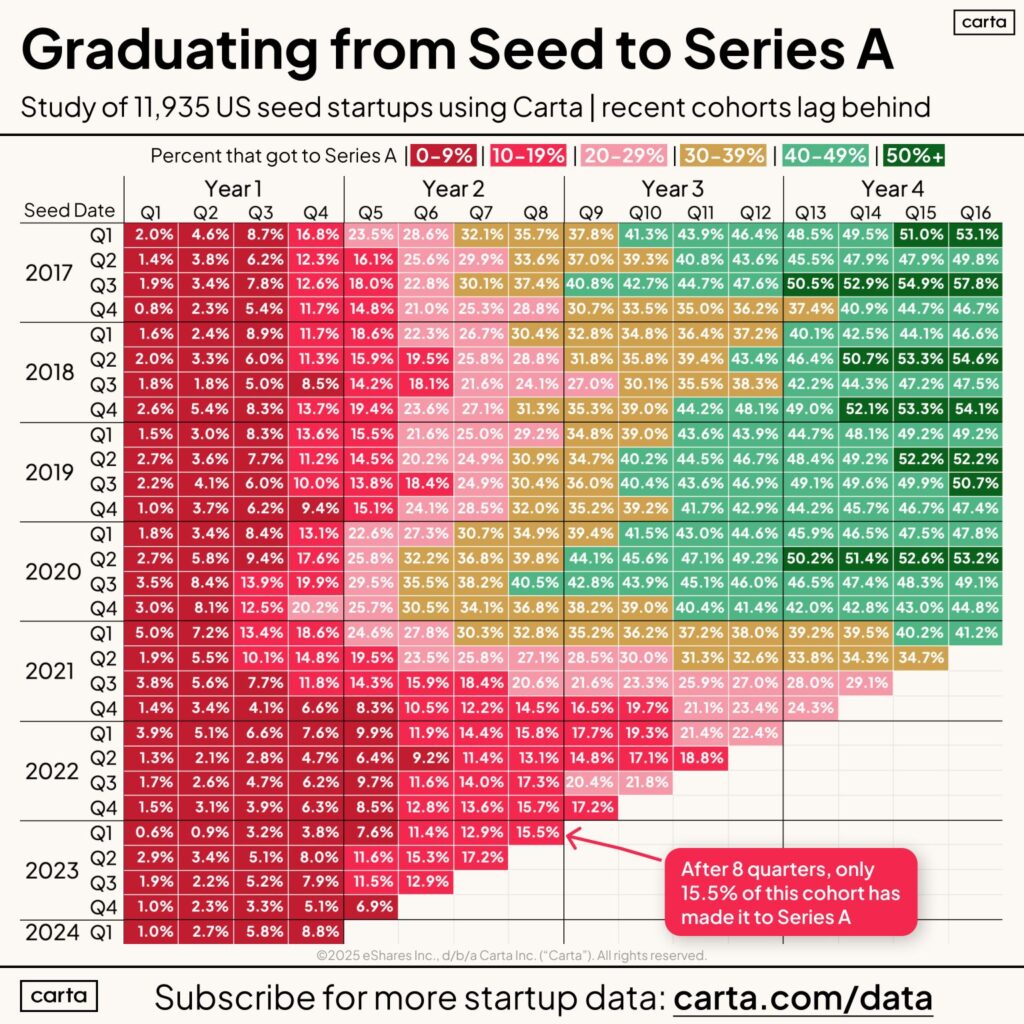
Securing a Series A round has always been challenging, but it has now become an even steeper uphill battle for many founders. According to Carta, only 15.5% of startups from early 2023 have managed to secure a Series A round after eight quarters: founders are increasingly finding themselves trapped here.
Several compounding factors converge:
- Lagging Metrics: The performance benchmarks required to raise Series A have risen, leaving many founders unable to meet the new, higher standards. Startups that raised significant capital during the bonanza period are now weighed down by their metrics, making further funding even more challenging.
- Unsustainable Valuations: Companies that previously raised at inflated multiples now struggle to justify those valuations, creating a severe funding bottleneck.
- Investor Fatigue: Nice or good traction is no longer enough as investors are turning their attention to stellar (and efficient) growth, often achievable only for AI-first companies. Additionally, many early investors have shifted focus to their top-performing investments or new opportunities, leaving less capital for follow-on funding.
- Persistent Burn Rates: Despite cost-cutting measures, many startups are still struggling to reduce burn without compromising growth prospects.
We do hope this gap is mainly due to startups following the seed-strapping strategy, but we are skeptical.
GoHub Ventures’ Perspective: Pros and Cons
Advantages:
- Reduced Dilution: With no subsequent funding rounds, early investors retain a larger ownership stake, potentially leading to significant returns upon exit.
- Sustainable Business Models: Seed-strapped startups often prioritize profitability and operational efficiency, aligning with investors seeking stable, long-term returns; dramatically lower chance of a complete loss on your investment.
- Founder-Investor Incentive Alignment: Both sides benefit from efficient and sustainable growth, focusing on real business metrics and building products the market genuinely wants. It also provides greater flexibility around exit timing.
Challenges:
- Delayed Liquidity Events: Without additional funding rounds, instruments like SAFEs may not convert promptly, potentially delaying returns for investors.
- Potential Limited Growth: The absence of substantial capital injections can constrain rapid expansion, possibly capping the company’s growth potential.
- Impact on Thesis: Many Series A-focused funds are now targeting the broader pool of opportunities at the Seed stage, creating larger VC competition at this stage, intensifying fragmentation of funding conditions between startups (risk of overpriced Seeds and potential need for extra funding). We are actively seeing a downward shift in thesis from Seed-focused funds to Pre-Seed stage, pushing funds to invest at above-market conditions to gain optionality for the Series A raise, if it even comes.
- Potential Returns: Is there a higher chance of better VC returns if there’s more funding capacity?
The Future of Startup Funding
While seed-strapping is gaining popularity in the U.S., it’s also resonating worldwide. We believe this phenomenon signifies a shift in the startup funding paradigm, where traditional VC model’s “power law” approach is less effective now, and founders are turning to seed-strapping to build sustainable businesses tailored to their unique market dynamics and funding perspectives.
As AI tools lower barriers to entry and founders seek greater autonomy, seed-strapping offers a compelling model for building resilient, profitable companies without the pressure of continuous fundraising.
For founders navigating this landscape, our Startup Fundraising Guide covers how to find the right investors and mistakes to avoid when raising. If you are planning on raising a Seed round or stuck in the plateau of seed-strapping, we’d love to meet you!

