
The traditional model of search, based on ranked lists and clickable links, is giving way to conversational experiences. Visibility is no longer about showing up first in a SERP, but about being cited in a direct response generated by an AI. Tools like ChatGPT, Perplexity, and Claude are redefining how users access information and, in turn, what it means to be visible online.
What is SEO for LLMs, and Why Does it Matter?
Brands now compete not only for human attention but also for recognition and citation by language models. In this context, SEO for LLMs becomes a strategic priority: language models synthesize content, select sources, and shape brand narratives.
This is the origin of terms like LLMO (Large Language Model Optimization), AEO (Answer Engine Optimization), or GEO (Generative Engine Optimization), also called AIO (Artificial Intelligence Optimization) or LLM SEO. While adjacent to traditional Search Engine Optimization, SEO for LLMs introduces key differences: no fixed rankings, no visible links. Visibility is determined by how the AI assembles its answers, not by how it ranks results.
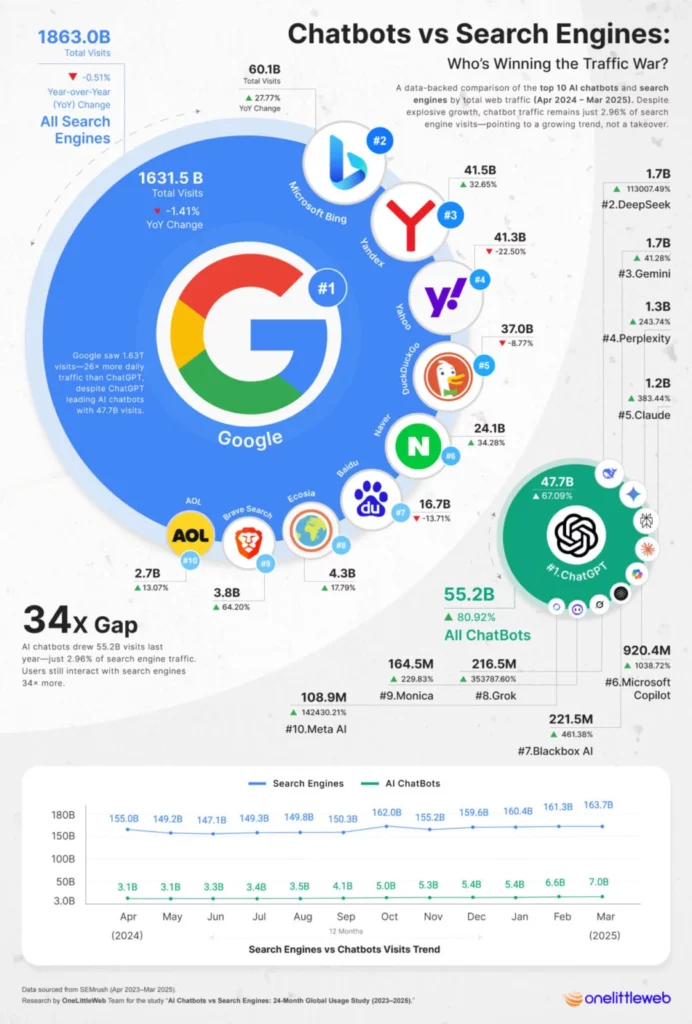
The shift is underway: AI tool traffic grew 80.92% year-over-year, reaching 55.2 billion visits. Google still drives 26x more daily traffic than ChatGPT, but LLM usage is climbing fast. Google holds 87.57% of the search market, while ChatGPT leads with 86.32% in chatbots. This isn’t a replacement, it’s a convergence: Google and Bing are integrating generative AI into their SERPs to stay relevant.
On May 7, 2025, Apple publicly validated this shift. SVP Eddy Cue confirmed that Safari had its first decline in search queries in 22 years, which Cue attributed to the rise of AI search. This has led the giant to start exploring integrations with engines from OpenAI, Perplexity, or Anthropic to Safari, as reported by Bloomberg.
Meanwhile, OpenAI is testing ecommerce integrations with Shopify in ChatGPT, enabling direct in-chat purchases. If scaled, LLMs could evolve from discovery tools into full conversion channels.
It’s not unthinkable that, in the wake of this shift, they may also explore advertising as a revenue stream, especially with the appointment of Fidji Simo as OpenAI’s CEO of Applications. As the former Head of the Facebook app, she played a key role in launching News Feed Ads and scaling Meta’s advertising business. Her arrival signals a renewed focus on turning cutting-edge AI into scalable, monetizable products. A new frontier for digital positioning may be closer than we think.
The Market: Startups, Products, and Investor Interest
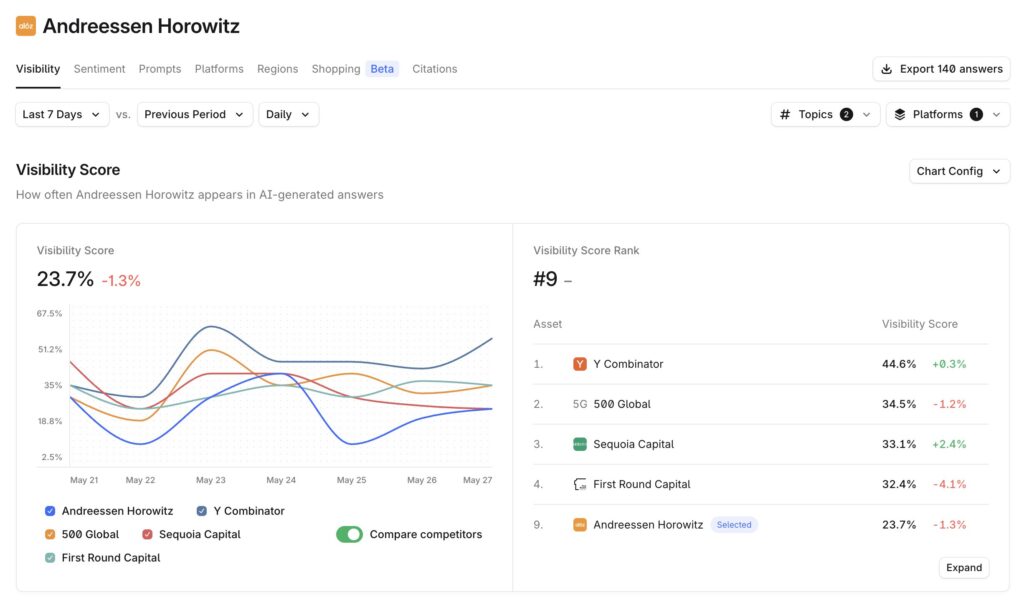
This emerging need has sparked a wave of SaaS startups helping brands monitor their presence in LLMs, understand the traffic they generate, and compare their performance against competitors.
The first wave of products typically revolves around three core functions: brand visibility in AI answers, sentiment analysis, and competitive benchmarking. Tools like Hall, Am I on AI? or Otterly.AI offer this basic functionality through accessible pricing.
Other startups are pushing the envelope with more advanced capabilities: source citation analysis, content optimization recommendations, multi-model dashboards, and demographic/geographic segmentation. XFunnel, for instance, compares how different models respond to the same prompt and suggests semantic improvements. Goodie, RankScale, or Peec AI stand out with features like visibility tracking, citation mapping, and content optimization hubs.
The signal from early-stage markets is clear. This emerging category is gaining ground among top accelerators: AthenaHQ was part of the Winter 2025 batch at Y Combinator, and the current Spring batch includes two new entrants, Relixir and Anvil, both focused on AI visibility and LLM optimization.
This early validation is mirrored in investor appetite. Recent Seed rounds include Profound ($3.5M), Evertune ($4M), Scrunch AI ($4M), AthenaHQ ($2.1M), Bluefish ($3.5M pre-seed), and Peec AI (€1.8M pre-seed). In Spain, companies like Omnia, founded by Daniel Espejo (ex-Klarna), have attracted strong interest. Meanwhile, established players like HubSpot, Semrush, and Botify (Series C, $50M) are also building their own AI visibility tools, further validating the space.
Analytics Is Mature, Optimization Isn’t (Yet)
Across dozens of platforms and conversations, a clear pattern has emerged: analytics capabilities are advancing rapidly. Tools can now track brand mentions across AI responses, identify source attribution, and measure visibility trends across models.
But optimization remains the tough part. Many tools offer visibility recommendations, but they’re often generic or hard to execute. The real breakthrough will come when tools can deliver specific, realistic, and contextualized suggestions that genuinely influence how models describe a brand. This challenge is deeply SEO-rooted. SEO for LLMs and optimization for SERPs share DNA in structure, semantics, and off-site reputation.
SEO for LLMs: Best Practices to Get Cited by AI Models
While there’s no definitive playbook yet, we’ve identified several practices that are proving useful. Some likely work because they align with SEO, while others may directly influence the heuristics LLMs use to generate responses. Either way, these are actionable starting points:
- Use question-answer formats: Headers like What is…? followed by clear, concise explanations are preferred.
- Implement schema markup: Use FAQPage or HowTo schemas to help models extract and rank content more effectively.
- Include long-tail, intent-rich keywords: Phrases like best CRM for remote sales teams outperform generic terms.
- Build off-site authority: Earn mentions on platforms like Reddit, Hacker News, or Quora.
- Optimize by model behavior:
- ChatGPT prioritizes Bing-based, well-structured content.
- Gemini emulates Google SERPs and looks for consensus patterns.
- Claude favors deep, highly technical, and fact-dense content.
- Perplexity favors YouTube and relies on crawlers like GPTBot.
- Grok leans on content from X (Twitter).
Add to this the rise of conversational commerce: if product discovery and purchases happen inside the chat, traditional website optimization matters less. What matters is being surfaced in the conversation.
New Rules, Open Field
Digital visibility is undergoing a fundamental transformation. It’s no longer just about ranking; it’s about being understood and cited by the models that increasingly mediate how people find information.
A dynamic ecosystem of tools is rising to meet this need. Analytics capabilities are maturing quickly. Optimization, while promising, is still in its early days. The startups that succeed will be those that help brands navigate this new terrain without compromising model integrity.
Yet big questions remain: How can we reliably measure AI visibility? What sources do models really trust? Will ads reshape the playing field?
One thing is clear: the rules are changing. And as with every tech transition, early movers will win. Ultimately, the question is simple, but strategic: If tomorrow’s search engine is an LLM… What will it say about you?