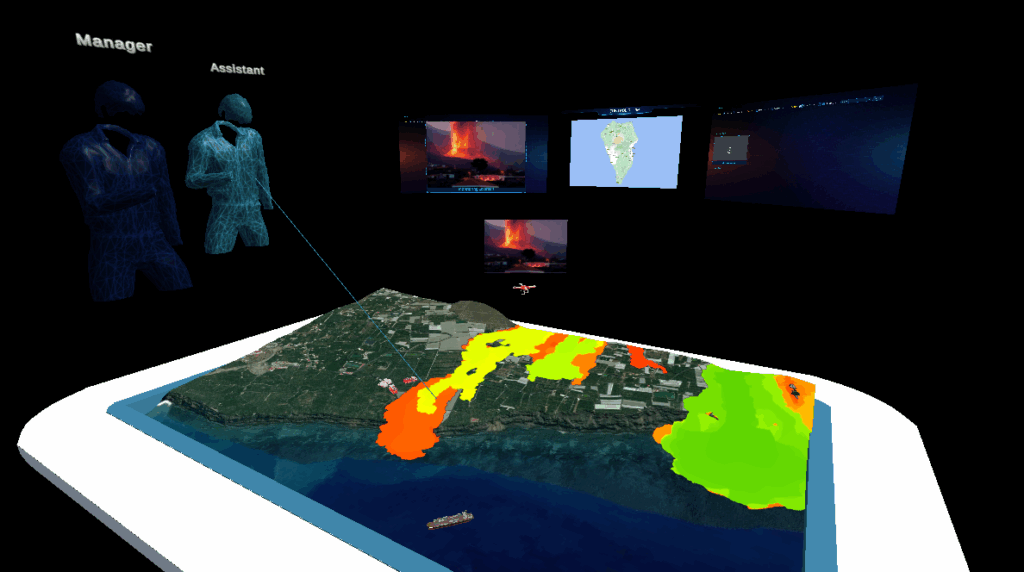
The global geopolitical landscape has undergone seismic changes in recent years, with Russia’s invasion of Ukraine and Gaza’s escalating conflict acting as key catalysts for a fundamental reassessment of Europe’s defense capabilities. This shift has driven an unprecedented resurgence in defense spending and highlighted the critical need for technological innovation in the European defense tech sector.
Traditionally, venture capital has been hesitant to invest in defense in Europe. However, the current urgency has transformed this perception, opening new and significant opportunities for startups and investors in the defense tech space.
This market map provides an overview of Europe’s defense sector: its funding trends, geopolitical drivers, and our personal predictions at GoHub Ventures.
Geopolitical Context and Its Impact
The current geopolitical environment is the key driver of Europe’s defense tech boom. Russia’s invasion of Ukraine has forced nations to urgently strengthen their strategic autonomy and modernize defense capabilities, triggering investment and impacting the sector in many ways:
- Defense Spending Growth: Between 2021 and 2024, EU member states’ total defense spending increased by over 30%, reaching approximately €326 billion in 2024, about 2% of EU GDP. This increase is part of a broader effort to replenish stockpiles, improve mission readiness, and develop new technological capabilities.
- The Role of the NATO Innovation Fund (NIF): Launched in 2023 with €1 billion in capital backed by 24 NATO allies, the NIF is bridging the gap between innovative startups and defense ministries, facilitating tech adoption and accelerating innovation. Investment in dual-use technology has surged since the NIF’s launch, showing its significant ecosystem impact.
- Accelerated Innovation: The urgent demand for new capabilities has spurred rapid innovation in areas such as AI, autonomous systems, cybersecurity, and space-based technologies. EUDIS accelerator is proof of this.
- New Partnerships: Closer collaboration between governments, established defense contractors, and agile tech startups is emerging to fast-track the development and deployment of cutting-edge solutions.
- Talent Attraction: The renewed sense of purpose and growing investment appetite are attracting top talent to the defense tech sector, further fueling its growth.
However, there are still long-standing challenges like interoperability, gaps in the value chain, or chronic underinvestment, presenting a unique opportunity for Europe to build a more cohesive and resilient defense industrial base, considering the urgency to scale defense capabilities by 2030.
European Defense Tech Market Map
To better understand the European defense tech ecosystem, we’ve developed a market map that categorizes the most relevant startups based on their technological/subsector focus and their funding/maturity stage.
With the help of XRF, a Spanish defense tech startup we’re proud to back, we’ve classified these players into five main technological subsectors: i) C4ISR / Situational Awareness; ii) Autonomous Systems; iii) Cyber & Secure Communications; iv) AI-Enabled Operations; v) Space & Satellite.
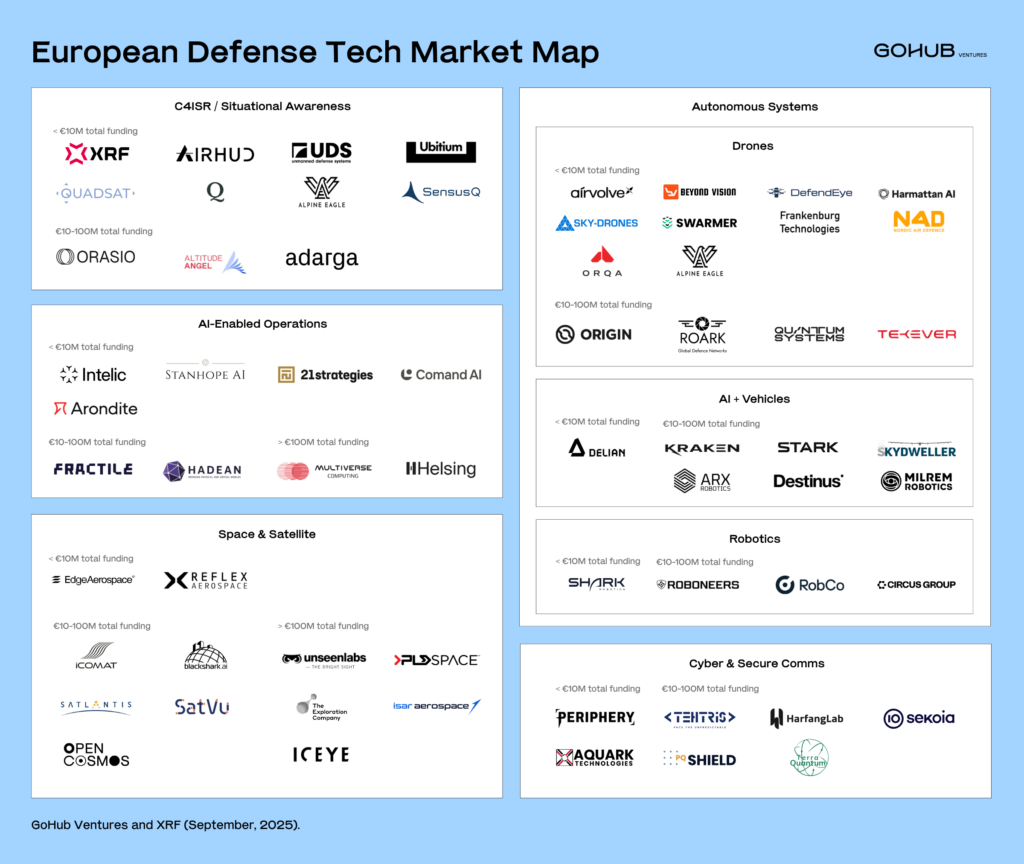
The map reveals several interesting trends and highlights the sector’s increasing diversity and dynamism, from early-stage companies to scaleups that have secured significant funding rounds.
- There is a concentration of startups in the Autonomous System category, highlighting the importance of autonomous drones and vehicle solutions in modern defense.
- AI-Enabled Operations also show strong representation, emphasizing the growing role of data and automation in security.
- Similar to AI-Enabled Operations and Autonomous Systems, the Space & Satellite sector includes some of the most well-funded companies and highest valuations, indicating this domain’s vast potential and strategic relevance.
- There is a healthy number of startups in early stages (Seed and Early Growth), demonstrating the ecosystem’s vitality and the constant emergence of innovation. Companies like Helsing, Quantum-Systems, TEKEVER or ICEYE have managed to attract substantial investment, solidifying their positions as leaders in their respective niches.
- Many scaleups in the market map span multiple sub-sectors as they grow, mainly as a result of increasing collaboration with governments and defense contractors and penetration down the innovation spectrum.
- There’s a growing amount of non-European investors participating in scale-up and growth stage rounds.
State of Funding and Sector Growth
As seen in the market map, the European defense tech sector has seen explosive growth in funding in recent years and there is a healthy (and growing) number of early-stage innovators. According to a McKinsey analysis, investment in European defense tech startups increased by more than 500% between 2021–2024 compared to the previous three years. In the first half of 2025, VCs funneled €946.2 million into defense startups, representing a substantial 26% increase from the same period last year. This surge is a direct response to the growing need to modernize defense capabilities and especially reduce dependence on external suppliers.
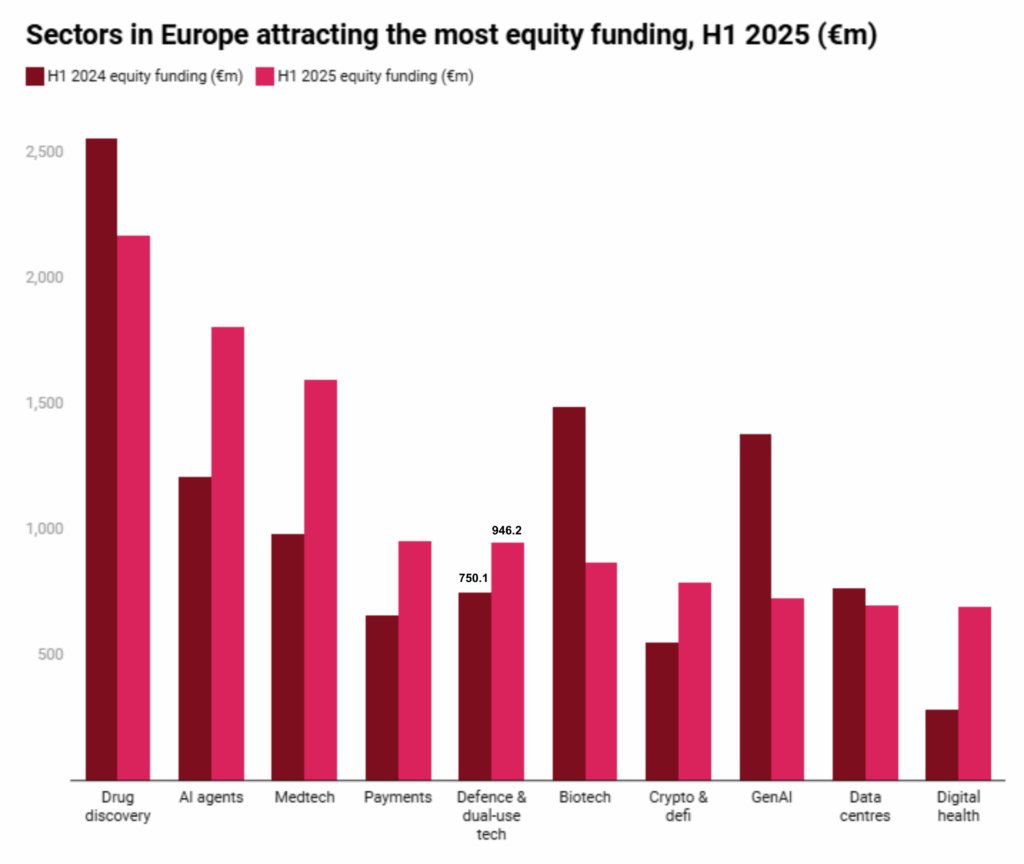
This investment surge is narrowing the gap with the U.S., which still records about 2.4x more deal volume. Proximity to the Ukraine conflict has accelerated European startups’ development, allowing some to move rapidly from concept to battlefield, and even lead in specific niches. Yet, late-stage funding remains a challenge, with U.S. and Asian investors dominating large rounds: nearly 60% of deals over $200M involve U.S. capital, highlighting the need for stronger domestic backers.
The market also shows a “Crowning the Winners” effect, where one company often captures over half of a category’s funding, as seen in both Europe (Helsing as a prime example) and the US (Anduril and Palantir). This dynamic is being constantly reinforced through growing trust and reliability with procurement agencies, making it difficult for new entrants but enabling established leaders to consolidate their positions.
VC Predictions on European Defense Tech
Driven by geopolitical imperatives and a historic surge in spending, Europe’s defense tech sector is at an inflection point and presents a compelling investment opportunity for VCs.
Below are our predictions for how the sector will evolve in the coming years and where the most promising opportunities lie:
- Consolidation & Specialization: More M&A as contractors acquire niche startups with strong IP; partnerships between startups and incumbents will also expand.
- Early-Stage Growth: Seed and growth funding will rise, supported by public initiatives and legitimized by high-profile raises like Helsing or TEKEVER.
- Dual-Use Tech: Startups with both civilian and defense applications (AI, cybersecurity, robotics, space, materials) will continue to attract more capital and align with ESG concerns.
- AI & Automation: AI-driven decision-making, intelligence, logistics, and autonomous systems will dominate demand; integration with hardware will be a key trend.
- Space-Defense Expansion: Falling launch costs and miniaturization will boost investment in satellite and space-defense solutions.
- Public-Private Collaboration: Governments will increasingly partner with startups through contracts, accelerators, and joint funds.
- New Tech Hubs: Beyond traditional centers, specialized defense hubs will emerge in countries like Germany, France, UK, Spain, Estonia, and Sweden.
Long story short, teams with sharp execution, clear market vision, and strong government relationships will stand out, while dual-use technologies provide additional resilience by opening civilian market opportunities and reducing downside risk.
As Gustavo Medina, CEO and founder of XRF, puts it: “At XRF we live by three principles: build first, contracts later; fail fast and cheap; and prioritize speed over perfection. In defense, waiting until everything is perfect means arriving too late. The winners are those who deliver quickly, learn in the field, and iterate faster than anyone else.”
From a VC perspective, Europe’s defense tech sector offers substantial return potential, driven by massive public spending, urgent innovation needs, and a dynamic startup ecosystem. The strongest opportunities will come from startups that not only deliver disruptive technologies but can also navigate complex regulatory and procurement landscapes.
The time to invest in European defense tech is now, as the geopolitical landscape continues to underscore its critical importance.
About XRF
XRF was selected as the only Spanish company to join EUDIS, the European Commission’s new acceleration program to boost defense innovation across Europe. The team is pioneering the use of extended reality and AI for decision making in complex scenarios and has positioned itself as a leading startup in the development of distributed command and control centers (C4ISR) for military operations, emergency and public safety.