
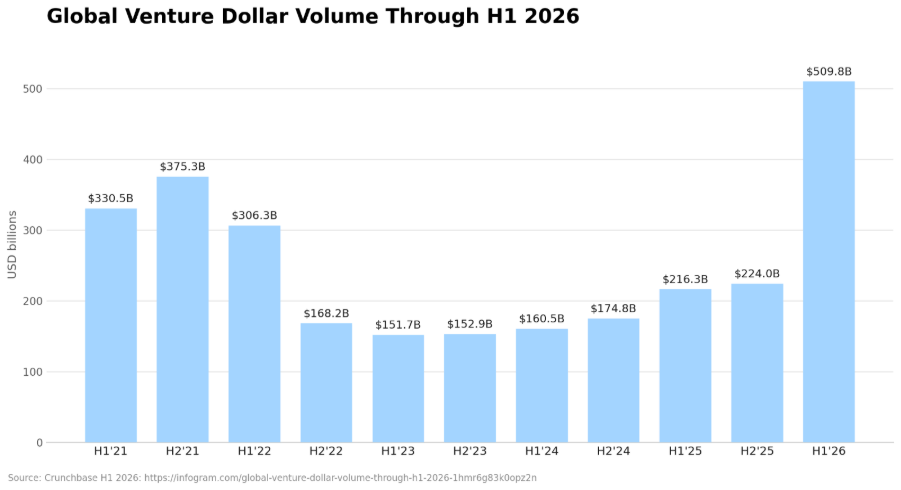
AI venture funding in H1 2026 reached $510 billion, more than the entire industry deployed in any full year on record and above the $440 billion invested across all of 2025. Q1 was the largest quarter ever at $305 billion, Q2 the second largest at $205 billion.
What that number contains, though, is two very different stories running in parallel. In the US, capital is concentrating around a small number of frontier labs and infrastructure bets at unprecedented scale. In Europe, the dynamic is different: a steady recovery, AI taking majority share of venture funding for the first time, and a clear shift toward larger deals in deep tech and applied AI.
The Pattern that Defines AI Venture Funding in H1 2026
Before analyzing the two markets, one observation applies to both. This is, AI investment in 2026 is concentrating in a small number of large rounds. Across the first half, OpenAI and Anthropic alone took $217 billion between them, some 43% of every venture dollar deployed worldwide. AI’s share of funding, meanwhile, pushed past 70% in the second quarter, up from roughly half a year earlier. Investors are writing fewer checks but dramatically larger ones.
Beneath the mega-rounds, seed dollars rose about 30% year-on-year while seed deal count fell around 31%. Series A rounds now raise a median of around $14 million across sectors, up from $8 to $10 million a few years ago, and AI startups price well above non-AI peers, with foundation-model labs reaching roughly five times their valuations. Billion-dollar rounds spread well beyond the frontier labs into AI infrastructure, defense, robotics and healthcare.
United States: When Venture Capital Becomes Infrastructure
The Four Rounds that Rewrote the Record Books
The US story begins with four Q1 transactions that, individually, would have defined any other year.
OpenAI raised $122 billion, reaching a post-money valuation of $852 billion. Anchored by Amazon ($50B), Nvidia ($30B), and SoftBank ($30B), it is the largest private funding round in history. The company is now doing $2 billion in monthly revenue, with enterprise above 40% of it, yet remains unprofitable, on track to lose around $14 billion in 2026 and not cash-flow positive until decade’s end.
Anthropic raised $30.6 billion Series G in February, then a $65 billion Series H in May at a $965 billion valuation that made it the most valuable private company in the world. In parallel, a court dispute with the Pentagon over autonomous weapons and intensifying friction with the Commerce Department forced it to pull its most powerful models on national security grounds. With OpenAI likewise limiting its newest model to government-approved partners, the year’s defining new dynamic is that Washington increasingly has a say in how the most capable models reach the public.
xAI raised $20 billion Series E in January, complicated by the subsequent departure of all 11 original co-founders. By May, xAI’s independent run had ended altogether, folded into SpaceX at a roughly $250 billion valuation.
Waymo raised $16 billion Series D in February. Alphabet’s autonomous driving unit is now operating at commercial scale across multiple US cities, making it the clearest near-term commercial success in physical AI.
Combined, these four rounds totaled $188 billion, more than the previous all-time record for an entire quarter of global VC.
Who is Actually Writing the Checks
The defining feature of Q1 is how completely strategic corporate money has displaced traditional venture capital at the frontier. The biggest checks came from Amazon, Nvidia, Microsoft and SoftBank, the firms that supply the cloud, the chips and the platforms these labs depend on, and their stakes buy priority access to compute and a foothold in the model layer, functioning as much like commercial partnerships as they do investments. At the frontier, the distinction between corporate strategic capital and venture capital has stopped meaning much.
The Hyperscaler Capex Layer
The venture rounds are only one layer of US AI spending. On April 29, the four largest hyperscalers collectively raised their 2026 infrastructure commitments to roughly $725 billion: Microsoft at $190B, Amazon at $200B, Google at $175-185B, and Meta at $125-145B. The largest concentrated capital expenditure cycle in technology history. On every call the message was the same: demand for AI infrastructure is supply-constrained and capacity cannot be built fast enough. It’s a claim that deserves caution. Meta’s shares fell when it lifted 2026 capex guidance to as much as $145 billion in April, then jumped when it signaled plans to sell its own spare compute, a reversal hard to square with a story in which no one can get enough. This capacity is added in enormous, all-or-nothing blocks, built on forecasts of future demand rather than orders already on the books, and the question shadowing the rest of the year is whether all this capex is running ahead of the revenue it is meant to serve.
What Q2 Delivered
If Q1 was defined by record private rounds, Q2 marked the start of the big exits the market had been waiting for. SpaceX went public on June 12, raising $75 billion in the largest IPO in history at a $1.77 trillion valuation, then used its soaring stock to buy Cursor’s maker Anysphere for $60 billion. Cerebras had listed weeks earlier and jumped 68% on its first day. OpenAI filed confidentially in May, though it may now wait until 2027, and Databricks ruled out a 2026 listing outright. With SpaceX and Cerebras already out, the AI companies still queued for public markets represent trillions more in value, and the early results suggest the appetite is there.
Europe: A Genuine Recovery with Its Own Internal Logic
Europe’s Strongest Half
Europe is having its strongest run since 2022. Venture funding reached $17.6 billion in the first quarter, up nearly 30% year on year, and the second came in stronger still at around $24 billion, the region’s best quarter in four years. Across the half, European startups raised roughly $42 billion, up about 50% year on year. The bigger shift was in the mix, as AI claimed more than half of all European VC for the first time, a $9.2 billion wave in Q1 alone.
The four largest European rounds of the half spanned AI and adjacent deep tech: Isomorphic Labs (UK, $2.1B, AI drug discovery), Nscale (UK, $2B, data-centre infrastructure), Neura Robotics (Germany, up to $1.4B, humanoid robotics) and Wayve (UK, $1.2B, autonomous driving).
The UK Leads by Every Measure
Over the full half the UK pulled in about $18 billion, its strongest six months since 2022 and more than double a year earlier, with the second quarter alone reaching $10.4 billion, just short of its 2021 peak. It accounted for more than 40% of all European VC across the half and is pulling ahead by every aggregate measure.
France as Europe’s Frontier AI Bet
France reached roughly $5 billion over the half, on track for its best year since 2022 though concentrated in a handful of mega-rounds. What matters is the type of company absorbing capital. Advanced Machine Intelligence, founded by Yann LeCun after leaving Meta to build a frontier lab focused on world models rather than LLMs, raised $1 billion in one of the largest seed rounds in European history. Combined with Mistral AI, Paris has established a genuine frontier AI cluster. This matters because frontier labs train the models that power everything built on top, making France the continent’s strongest bet at holding a seat at that table.
Germany’s Defense as a Growth Sector
Munich is displacing Berlin as Germany’s primary capital magnet, with capital shifting from consumer internet toward deep tech and defense, and German startups raised $3.2 billion in the second quarter alone. Across Europe, defense technology has moved from a controversial category to a mainstream investable asset class, backed by rising government procurement and EU rearmament. Helsing, the Munich-based AI defense manufacturer, is closing a reported $1.2 billion round at around an $18 billion valuation that would make it Germany’s most valuable startup.
Spain Among Europe’s Fastest Risers
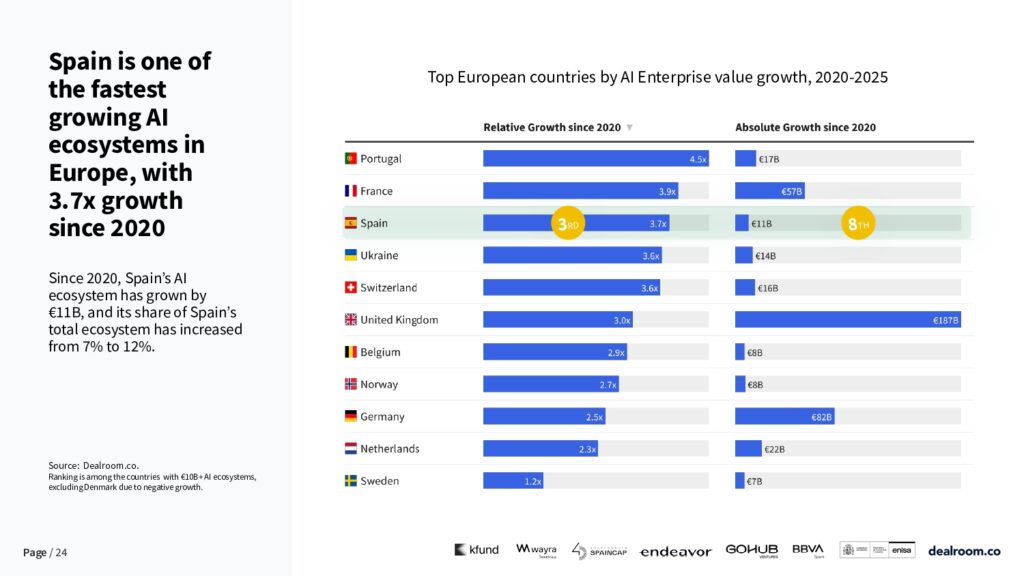
Spain sits inside the same recovery on a smaller scale. The Spanish Tech Ecosystem Report 2026 ranks it among Europe’s fastest-growing markets for AI investment, third on the continent for the pace of that growth. On Dealroom figures, its start to 2026 was among the strongest on record, with startups raising about $1.3 billion in the first quarter and $1.14 billion in the second, roughly $2.4 billion across the half, making the first quarter the highest in the series since 2020. As across the region, most of that money went to a small group of large rounds rather than spreading widely across the ecosystem, though early-stage funding actually strengthened between the two quarters.
The Same Theme, Different Weight Classes
The most honest framing of US versus European AI investment in 2026 is about scale and emphasis more than about who is ahead. Both back the same frontier and deep-tech themes, and the difference is where the weight sits. US capital concentrates on the foundational layer of frontier labs, training compute and inference infrastructure, on the thesis that whoever controls the model layer captures value from everything built on top. That bet needs enormous upfront capital and tolerates sustained losses, with OpenAI spending about $1.60 for every dollar it earned in 2025, down from $2.37 the year before, in pursuit of winner-takes-most dynamics.
European capital leans toward deep tech and physical infrastructure, from biotech and quantum to semiconductors, robotics and energy, alongside its own frontier labs in London and Paris. Europe builds at the model layer too, at a fraction of the US scale, with its edge in regulated domains where engineering and compliance create defensible moats rather than in the capital-intensive compute race.
One development complicates the US thesis. A wave of open-weight models through the first half, most from Chinese labs like DeepSeek, Alibaba’s Qwen and Moonshot, closed the gap with leading closed systems to within a few points on coding and reasoning, at a fraction of the cost. If a downloadable model handles most everyday work for a tenth of the price, owning the model layer looks like a weaker guarantee of outsized returns, a quiet counter-current beneath a half defined by hundred-billion-dollar rounds.
What to Watch in H2 2026
The IPO test. With SpaceX now public, having surged initially before correcting back close to its offer price, the remaining signals are the listings of OpenAI and Anthropic themselves. If these succeed, they validate 18 months of private market valuations. If they don’t, the correction will be significant.
Europe’s seed gap. The 44% decline in European seed deal count in Q1 is the most quietly important data point on this side of the Atlantic. Fewer companies funded at seed today means a thinner pipeline reaching growth stage in 2027-2028. If this pattern holds through H2, it becomes a structural concern that the headline revival numbers obscure.
The pricing shift. Frontier models keep getting better but also more expensive, and venture subsidies that kept prices low are giving way to per-token enterprise billing. The question for H2 is whether that climb continues or competition pulls prices back down, and either way many AI deployments will need their economics recalculated.
Bottom Line
The real divide in venture funding in H1 2026 is about capital allocation more than technology, and it falls along geopolitical lines. The US is pouring money into the foundational layer, betting that whoever controls it captures the value built on top. Europe spreads its capital across deep-tech and verticals with steadier economics and less structural reach. What matters over the next five years is who ends up owning that foundational layer and whether it stays as defensible as today’s largest cheques assume.