
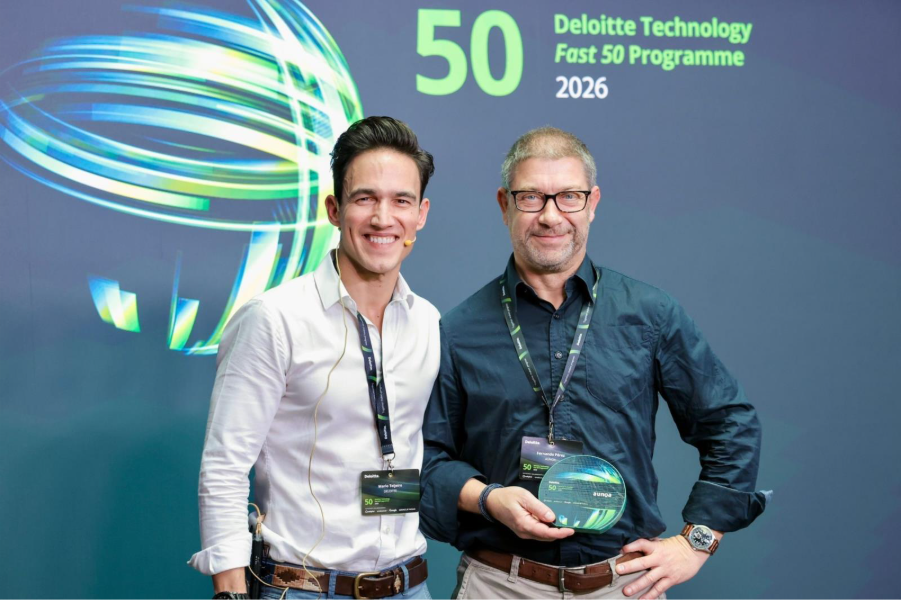
Scaling an AI company in today’s market requires disciplined execution, clear positioning, and the ability to evolve alongside rapid technological change. Recognized in the Deloitte Technology Fast 50 Programme, Aunoa has grown its revenue by 327% over the past four years, becoming one of Spain’s fastest-growing technology companies, with GoHub Ventures supporting their journey from the very beginning.
We spoke with Fernando Pérez Borrajo, Corporate Director and co-founder of Aunoa, about the key drivers behind their growth, the operational challenges of scaling, and how they continue to refine their product and technology strategy in an increasingly competitive conversational AI landscape for customer service.
Aunoa has been recognized as one of the fastest scaling companies in Spain. What do you believe were the key drivers behind this growth?
Three factors explain this result. The first is timing: we started building in 2019, just as AI was beginning to demonstrate real value, which allowed us to reach the market with maturity when demand took off. The second is focus: we never wanted to be a generalist platform, but rather a complete solution in sectors where conversation has a direct impact on business. And the third, without a doubt, is the team. We are 32 people who are highly committed to a clear purpose, and that cohesion translates into execution.
What were the biggest operational challenges you faced while scaling, and how did you address them?
The most difficult challenge has been to grow sustainably without compromising quality. When you start scaling up in regulated sectors such as banking or insurance, customers expect the same level of rigor for customer number one as for customer number twenty. This forced us to professionalize our operations very early on: clear delivery methodologies, robust QA processes and a support team to accompany the customer beyond the initial implementation.
The other major challenge was technological evolution: generative AI transformed the technology almost overnight, and we had to make quick strategic decisions without losing the stability and regulatory compliance that our customers demanded. And we faced it with internal honesty: prioritizing, discarding what no longer made sense and betting heavily on what did.
How did you structure and grow your team to support rapid expansion while maintaining focus and execution quality?
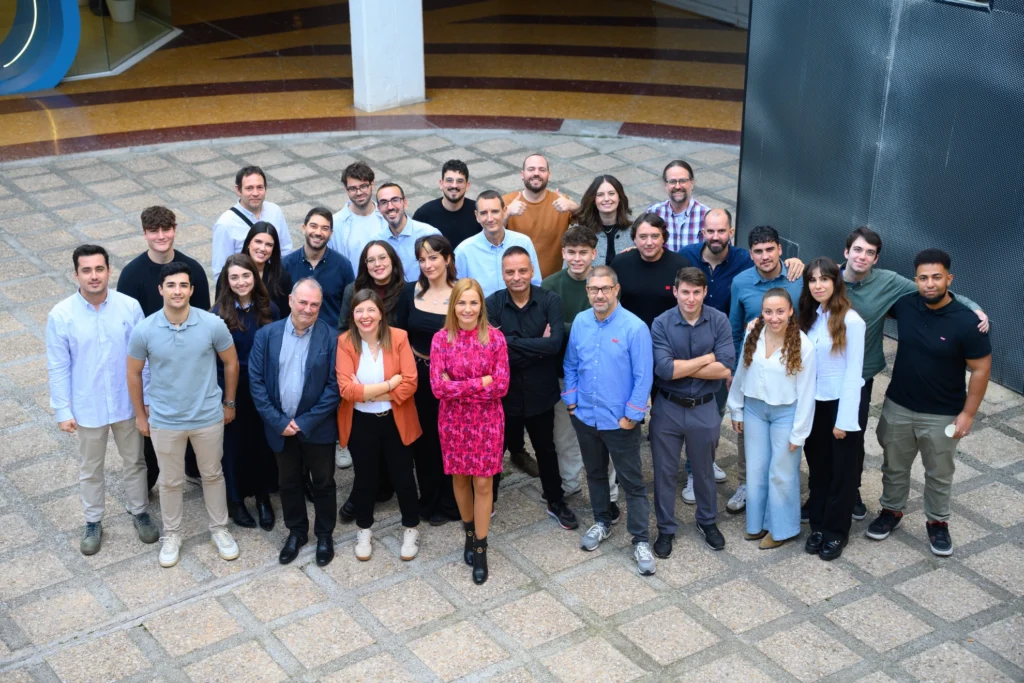
We have grown slowly and with care. Now we have 32 employees, and we carefully consider each new hire. We look for people who can contribute from day one and understand that in a company like Aunoa, everyone has a direct impact. We have built a culture in which autonomy and responsibility go hand in hand, allowing us to operate with an agile structure without losing coherence.
Aunoa operates in the increasingly competitive conversational AI space. How did you differentiate early on, and how do you sustain that differentiation today?
Initially, the differentiation was due to our sector focus. While many competitors offered horizontal solutions, we specialized in conversational flows specific to banking, insurance, logistics and utilities: claims, contract management, after-sales service and regulated processes. This allowed us to build domain knowledge that is very difficult to replicate. Today, that differentiation is sustained by combining that knowledge with the most advanced generative AI capabilities. We are not a ChatGPT wrapper; we are a layer of intelligence that understands business context and applies it reliably and in a controlled way. In sectors where a mistake has real consequences, that is worth a lot.
How has Aunoa’s product evolved since its foundation? What were the most decisive iterations?
We started with a product that had to prove its worth in real-world conditions. The first iterations showed us that business customers don’t need impressive technology; they need technology that works predictably and, above all, integrates well with their systems. The most decisive leap came with the emergence of generative AI: that was when we were able to take a huge qualitative step forward in the product’s capabilities without sacrificing reliability. Today, the product is much more powerful than it was two years ago, but it remains recognizable by its philosophy: simple for the customer, complex on the inside.
With the rapid evolution of generative AI and LLMs, how has your technology strategy adapted over the past two years?
It has been the most exciting period since we founded the company. Generative AI was not a threat to Aunoa; it was a huge accelerator. It allowed us to do things that were previously unfeasible or required disproportionate effort. We took a very cautious stance on reliability: LLMs are powerful but unpredictable if not well orchestrated, and we operate in environments where that is not acceptable. So, our strategy has been to integrate these capabilities in a controlled manner, using layers of validation and supervision to ensure the consistency of the system’s behavior. We are agnostic about the models, but very demanding about how we use them.
In AI-driven products, performance and accuracy are critical. How do you ensure consistent quality while scaling deployments across multiple enterprise clients?
This is probably the most important technical and operational challenge we face every day. Our response is based on three pillars. The first is parameterization: each implementation is tailored to the client’s specific context; we never apply a generic solution. The second is continuous monitoring: we have human supervision in place that allows us to detect inconsistencies before the customer notices them. And the third is support: we don’t just deliver a product and disappear; we work continuously with customers to iterate and improve. It’s an ongoing process.
What is the biggest lesson you have learned about scaling an AI company in today’s market?
That technology is not the most difficult part. The really difficult thing is building trust: customer confidence that the system will work, team confidence that management has a clear direction, and market confidence that you are not a fad but a long-term commitment. In a sector as noisy as AI, where every week something new emerges promising to revolutionize everything, consistency and honesty are a huge differentiator. We have learned to say no when something does not fit with who we are, and that has given us more than it has taken away.
What role has GoHub Ventures played in Aunoa’s journey so far?
It was huge; GoHub Ventures was our first investor, and not just at any time, but during the COVID-19 pandemic. Not only was it the first investor to believe in our project, but it did so at a very difficult time. Those initial months were very complicated, and it was impossible to validate or sell anything. And then, beyond the financial backing, it has given us access to corporate knowledge that has been very valuable for a company like ours, which operates precisely in the environment of large corporations. Having GoHub Ventures as a reference has opened doors for us and given us credibility in conversations that, without that backing, would have taken much longer. It is a relationship that we are very happy with, and that has made a real contribution to where we are today.
Looking ahead, what are the key priorities for Aunoa over the next 12 to 24 months?
We have three clear priorities. The first is to consolidate and expand in the sectors where we already have a strong presence. We want to be the undisputed leader in conversational AI in banking, insurance, logistics and utilities in the Spanish market. The second is to expand operations into other markets, mainly in Latin America, where we already have significant market share and a physical presence. And the third is the team: we want to continue growing with the right people and build a company where everyone feels they are contributing to something meaningful. Recognition, such as the Deloitte Fast 50, is not a turning point nor a point of arrival; we aspire to remain in that ranking for a long time.

