
Industrial companies have more data than ever, but turning it into clear decisions remains a challenge. External factors such as prices, demand shifts, and supply disruptions are often hard to connect to day-to-day operations. That is why supply chain decision intelligence is becoming increasingly important.
Sybilion is building in that gap, connecting external signals with internal decision-making in a more structured and actionable way. The company recently raised a $4.2M seed round, co-led by VentureFriends and Semapa Next, with support from GoHub Ventures and earlier backing from Vanagon Ventures and EWOR, to further develop its platform and deepen its integration into industrial workflows.
These are some of the reasons behind our decision to support the company.
The Team: Strong First Signal
Our initial conviction started with the team. When the company was first introduced to us, what stood out immediately was the profile of CEO Bjol R. Frenkenberger, whose background is clearly unconventional: starting university at 12, becoming a world-class pianist, building a data analytics company in Tokyo, and later pursuing a PhD at Oxford focused on decision-making under uncertainty.
That initial signal was enough to get our attention. The strength of the team extends beyond the CEO, combining technical depth and industry experience:
- Nuno Barros (CTO): Experience leading product teams, with a background in machine learning and data science.
- Jonas Falkner (CDO): Applied research experience in forecasting and supply chain software, with a PhD in Artificial Intelligence.
- Friedrich Weninger (CCO): Over 25 years of experience in industrial environments, including leadership roles at Lenzing Group.
After speaking with the team, it became clear that behind this background there is a strong understanding of both the problem and the space Sybilion is operating in. In industries where complexity is high and adoption cycles are long, that level of understanding is critical early on.
A Large Opportunity in Industrial Supply Chains
Sybilion focuses on industrial supply chains, particularly in sectors like chemicals, plastics, and textiles. It takes a verticalized approach in areas where inefficiencies in forecasting and supply chain decision intelligence remain significant. These are large markets, but also traditionally difficult to penetrate.
Companies regularly make high-impact decisions using spreadsheets, delayed reports, or partial data. In volatile markets, being off by a few weeks in procurement or hedging can have a direct impact on margins.
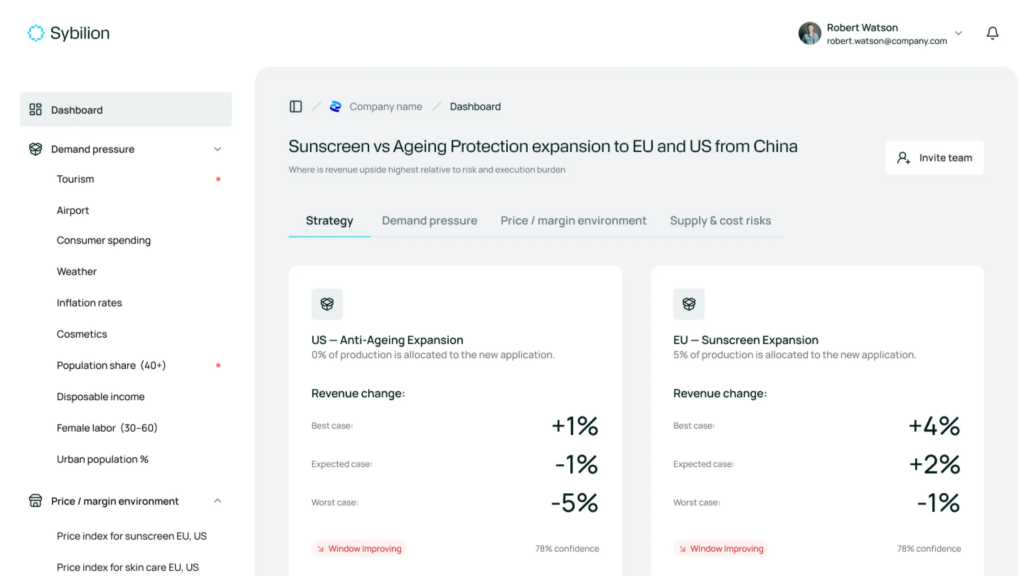
This creates a clear need for better decision-making infrastructure. Sybilion’s approach is not to generate another forecast, but to connect external signals such as freight rates, energy futures, weather, or trade flows to a company’s internal exposure, and make it easier to understand when to act and what trade-offs are involved.
Early Traction in a Difficult Market
Beyond the team, one of the other reasons that made us bet on the company is the traction they have achieved in a relatively short period of time. Over the last year, Sybilion has grown from $17.5k to $700k in ARR, with zero churn, all without a dedicated sales team. Growth so far has been entirely founder-led.
This is especially notable given the nature of the market. Industrial companies are traditionally slow to adopt new technologies, and trust cycles are long. Early traction with zero churn is a strong signal that the product is delivering tangible, measurable value.
It also reinforces a key point: this is not a “nice-to-have” analytics tool. It is becoming part of how decisions are made.
The Decision Layer for a More Agentic Economy
As outlined in our VC trends to watch in 2026, the transition toward a more agentic economy is already underway, with autonomous systems becoming increasingly embedded across procurement, logistics, and financial workflows. As this shift progresses, the way decisions are made is also evolving, moving from manual and reactive processes toward systems that rely on structured signals, context, and forecasting to operate effectively.
In this context, the challenge is not only access to data, but the ability to determine which signals are relevant, how they relate to a company’s specific exposure, and when action should be taken. This creates a need for a supply chain decision intelligence layer that connects external dynamics with internal decision-making in a more structured way.
Sybilion is building that layer by integrating into existing systems and augmenting workflows with continuous signal processing and decision support. This helps teams interpret external changes with more clarity and act on them with a better understanding of trade-offs. Over time, this positions the company as part of the infrastructure that supports how organizations operate in increasingly automated and volatile environments.
Data as a Compounding Moat
At the core of the product is data, and its performance improves as more data flows through it. Defensibility comes from that accumulation. Each new customer contributes additional signals and validation loops, refining how those signals are interpreted across different contexts and use cases.
As this process continues, the platform becomes more accurate and better reflects how decisions are actually made within different companies. The result is a flywheel: more customers generate more signals and feedback, which improve decision outputs, strengthen the value of the platform, and in turn attract more customers.
In practice, this means that as the product scales, it becomes harder to match the level of accuracy and reliability it achieves.
Why We Backed Sybilion
Our decision to support Sybilion is grounded in three key elements:
- A team with a strong ability to understand and operate in a complex, underexplored space.
- A large and inefficient market where better decision-making can have direct financial impact.
- Early traction that validates both the product and its relevance.
We believe Sybilion is tackling a critical gap in industrial decision-making at exactly the right time. As supply chains grow more complex and less predictable, companies will need better systems to interpret change and act on it. That is what makes Sybilion such a compelling company for us to back.