
If we drew a timeline of how AI has shaped startup solutions, it would begin with early algorithms: systems that enabled content personalization, user behavior prediction, or basic matching models. These rule-based or statistical engines marked the first wave of intelligent automation, optimizing decisions quietly in the background.
The next major leap came with large language models (LLMs), which transformed AI from a backend utility into a front-facing interface. Chatbots began to hold natural conversations and search tools evolved into creative partners, helping users brainstorm, write, generate images, or even launch digital products within hours.
Today, we stand at the edge of a new era driven by autonomous AI Agents, capable of completing complex, multi-step tasks with little to no human input. It’s a breakthrough we’ve already explored in our blog.
To gain first-hand insight into Agentic AI, we spoke with Vicent Soler, CEO and co-founder of Kenmei. This GoHub-backed startup helps mobile operators optimize and automate network operations through AI-driven analytics and intelligence.
No More Software for Engineers: Agentic AI Is Taking Over SaaS
Kenmei’s CEO echoes a powerful prediction made by Microsoft’s CEO Satya Nadella in late 2024: “AI agents will replace traditional applications and SaaS (Software as a Service) platforms.” This signals a fundamental shift in how we design and interact with business software.
“Instead of engineers manually retrieving and analyzing data, agents can autonomously access the information and either make decisions or significantly accelerate the decision-making process,” explains Vicent Soler. “That frees engineers to focus on higher-value work, making operations far more efficient.“
This leap in productivity opens up major scalability opportunities for businesses, one of the main reasons companies are racing to develop agent-based solutions.
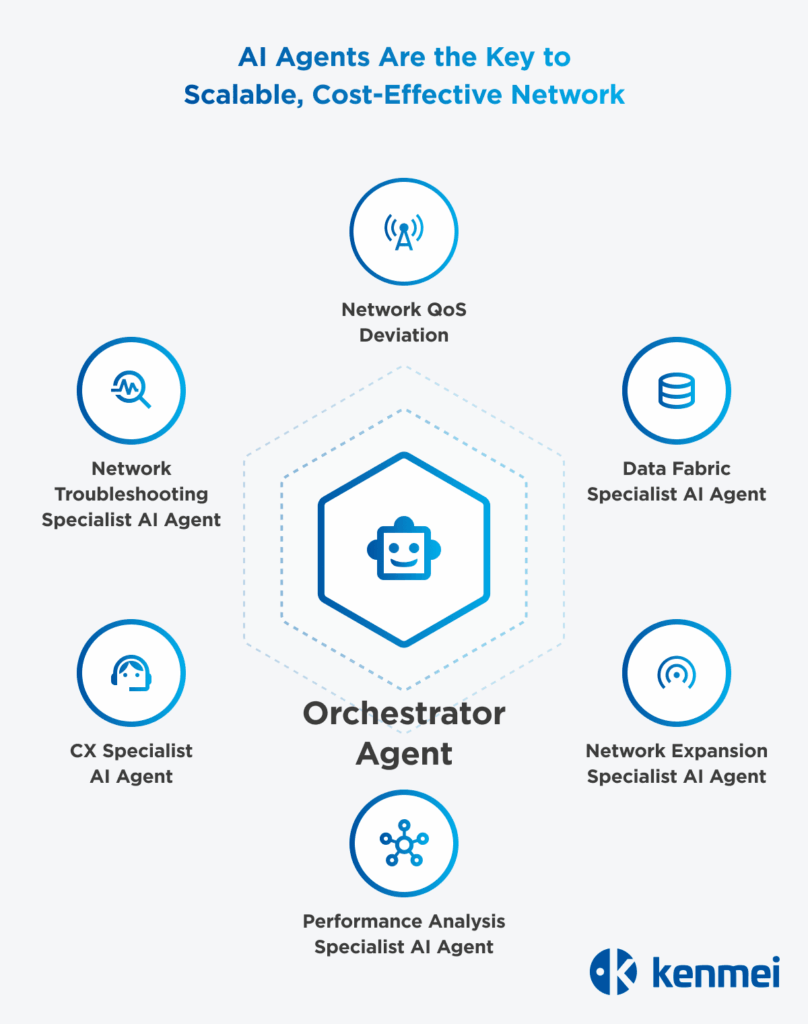
“We’ve been working with AI since day one,” Soler says, “though back then it was mainly around machine learning algorithms and expert systems.” Speed is key when building a true AI-startup, so “the day OpenAI announced ChatGPT we immediately began building an assistant that would let telecom operators access information using generative AI,” remembers Kenmei’s CEO. “Since then, that assistant has naturally evolved into a full Agentic AI solution with specialized agents”.
In the telecom space, Kenmei’s core industry, these agents are a direct evolution of existing products. “Our agents autonomously access and combine multiple data sources to solve everyday challenges for telecom engineers,” Soler says. “They can analyze user issues at the communication protocol level, investigate network optimization problems, or even predict network growth.”
Nadella’s remarks may only be a year old, but they resonate deeply with Kenmei’s long-term vision. Back in 2018, the team chose a .ai domain, subtle, yet symbolic of their belief that AI would define the company’s future. “Our goal has always been to automate telecom network data analysis through AI. But we also knew that without reliable, accessible data, there can be no AI. That’s why building a strong data layer has always been a top priority for us.”
Selling AI to Legacy Telcos
Large corporations operate at their own pace, often with cultures far removed from the agility and forward-thinking of startups. As Kenmei’s CEO puts it, “being small in a world of giants makes it difficult to open doors… first, because they don’t know you, or you’re not yet on their radar, but second, because there’s a fear of making the wrong choice.”
It’s the ‘nobody ever got fired for buying from a Fortune 100 company’ effect that captures how big enterprises tend to stick with large, established vendors, even when startups may offer technically superior solutions. “Even if your product is the best,” Soler says, “decision-makers often choose big providers because it feels safer if something goes wrong.”
Still, that mindset is shifting, especially among operators dealing with emerging challenges. “When there’s a need for new, more advanced solutions, some are more open to working with startups because legacy solutions just don’t cut it anymore in those cases.” The key to winning their trust? “Being technically outstanding, that makes everything else easier,” he reveals.
Kenmei focuses its efforts on the technical stakeholders, the engineers, who are the end users of their AI products. “We’re talking about companies with thousands of employees. Knowing the right door to knock on isn’t always easy, but there are ways to navigate the org chart,” he explains. Industry events like MWC Barcelona or DTW Copenhagen are essential touchpoints, as is visibility through specialized media. “We leverage marketing like companies in any other sector, it’s what gets us noticed.”
Europe, AI Regulation, Scaling Beyond Telecom and More
Asked about Europe’s often-criticized regulatory stance on AI, Soler backs the continental legislation: “Telecom has dealt with sensitive customer data for years. We’re used to strict regulation. We actually believe user data should be treated as sacred. Guaranteeing privacy and responsible AI use is essential, and data security is one of the biggest global challenges we face.”
We’re also curious if Kenmei’s technology could expand beyond telecom, so we asked the CEO about it.
“Our systems are built to handle massive data volumes, tens of terabytes per day. While the core tech is scalable across industries, our DNA is in telecom. That’s where we specialize,” according to Soler. Still, he points to cybersecurity as a particularly promising space. “We see a lot of untapped potential in how our solutions could bring value there.”
Also, since it’s almost a year since the latest investment by Kenmei (€4M led by Andorra Telecom and backed once again by GoHub Ventures), we asked for the outcome of that round.
“The funding allowed us to level up in multiple areas,” says Soler. “First, marketing. As engineers, we hadn’t paid much attention to promoting our products. That’s changed. Our communication strategy is now much more active and effective.”
The funding also fueled growth in two strategic teams: technical and sales. “We’ve brought in high-level engineering talent to keep innovating in areas like AI Agents, and we’ve expanded our commercial team. That’s been key in opening up new opportunities, with a pipeline worth tens of millions of euros.“
What wrap-up advice would Soler give to other entrepreneurs looking to innovate in traditional sectors with emerging technologies like AI?
“AI and other advanced tech can bring huge value. They solve problems that were previously impossible. But to succeed as a company, you must go beyond the tech; you have to solve real problems for real customers. Always ask yourself: How does this solution help my customer? If you can answer that clearly, you’re building something with real value. And that’s the foundation of a successful startup.”

