
Imagine a team of engineers walking into your office and pitching you their project. They want to build a rocket and launch it into space, and they have a plan broken down into three phases.
In Phase 1, they need €500,000 to build the rocket and test the engine on the ground. The probability of success at this stage is 30%. If that works, Phase 2 requires €5 million to send the rocket into the sky and test all systems remotely, with a 50% chance of success. If they get that far, Phase 3 needs 50 million euros to fuel the rocket and complete the actual launch to the moon, with a 70% probability of success.
Here is the question: would you hand them all €55.5 million on day one?
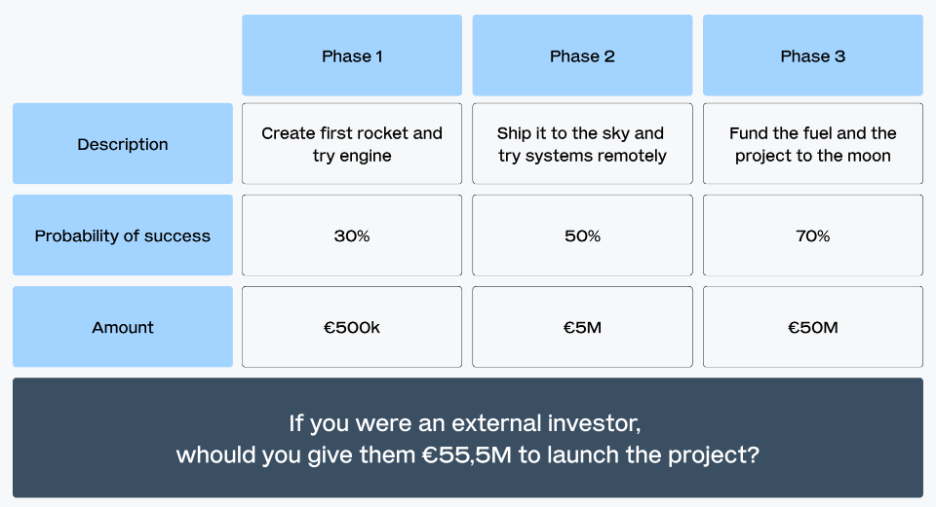
The rational answer is no. Not because the project is bad, but because on day zero you do not have enough information to know whether the team can execute, whether the technology actually works, or whether the approach is correct. You release capital as the team proves they deserve to keep receiving it, which is precisely the logic that sits at the core of how funding rounds work.
A funding round is a structured mechanism for distributing risk over time between two parties that have different levels of information at each point in the journey, not just a transaction where someone hands over a check.
This is part of our Startup Fundraising Guide, where we break down how raising capital actually works. Before the deck, the pitch, or the first investor meeting, it helps to understand the game itself: why startup funding rounds exist and what each one is really for.
The Reality: Most Rockets Never Make It to the Moon
The startup ecosystem works in a very similar way. Not every company that raises a Seed round makes it to Series A. Not every Series A company reaches Series B. And very few ever go public or get acquired at favorable terms.
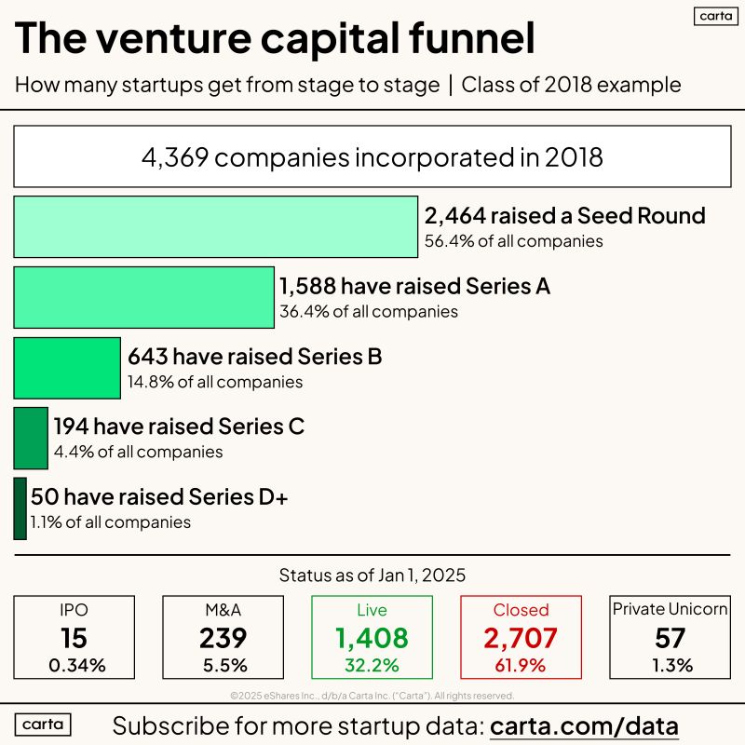
Looking at the class of 2018 through Carta’s data, of 4,369 companies incorporated that year, 56.4% managed to raise a Seed round. Only 36.4% reached Series A. Just 14.8% made it to Series B. And a mere 1.1% raised a Series D or beyond. By January 2025, 61.9% of those companies had closed.
This is not to intentionally scare founders off, but it’s important to understand clearly what kind of game this actually is. Venture capital is a probabilistic model where most bets do not work out, and where the total return of a fund depends on a small number of companies that do. Funding rounds are the mechanism that allows investors to manage that probability in a rational and structured way, with each round acting as a checkpoint rather than just a transaction.
From the founder’s side, understanding this changes how you think about fundraising entirely. The real argument behind every raise is that your company is less risky than it was the last time someone wrote you a check, and that the capital you are asking for now has a better chance of generating a return than the previous round did.
The Risk Each Startup Funding Round Eliminates
One of the most common misconceptions among founders is thinking about fundraising as a linear process where you simply “need more money to grow”. The reality is more precise than that: each round exists to eliminate a specific type of risk.
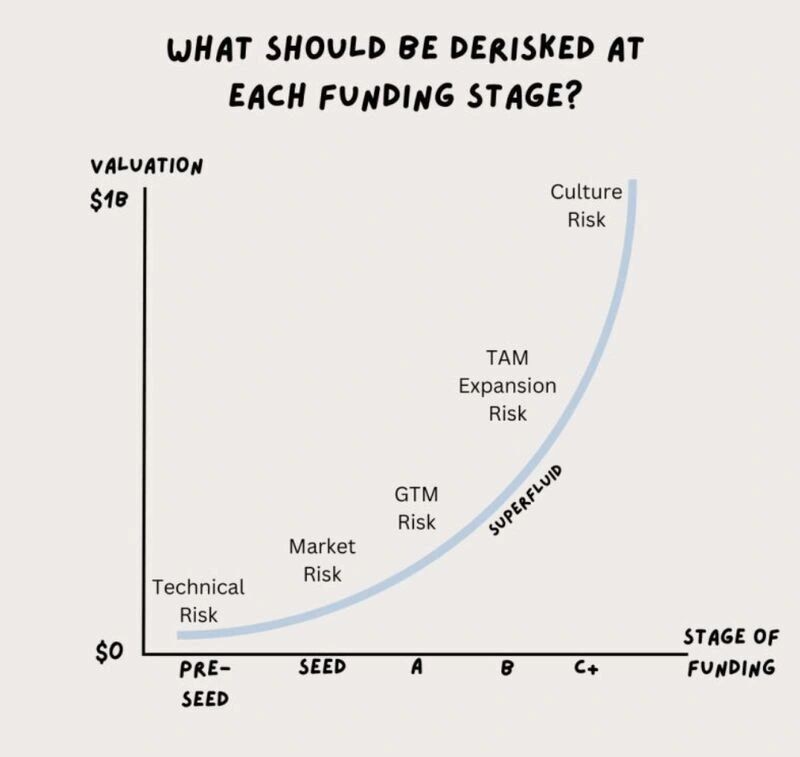
In the pre-seed and seed stages, the dominant risk is technical; has the team actually built what they say they are going to build? At Series A, the focus shifts to market risk: is there a real customer willing to pay for this product? At Series B, the risk becomes about go-to-market: can the company sell and scale in a repeatable way? From Series C onward, the risk evolves into total addressable market expansion and, eventually, organizational culture.
A pattern that shows up consistently across the ecosystem is that many companies fall apart in the transition between Seed and Series A, and the reason is almost never technical. They managed to build something that works, but the problem is that scaling distribution is a completely different challenge from building the product itself.
Reaching product-market fit is hard but finding it does not automatically mean you know how to grow. That requires figuring out the right channels, structuring a sales team, defining a clear ideal customer profile, and operating with enough discipline to do it efficiently. These are management challenges, not engineering ones. Series A capital is meant to fund that transition, but it does not guarantee it will work.
This is why investors at each stage are looking for different signals. A seed investor is asking whether the technology is real and whether the team has the right skills. A Series A investor is asking whether the product has genuine traction and whether the market is large enough to justify going all in. A Series B investor is asking whether the go-to-market motion is efficient and repeatable. The same company gets evaluated through a completely different lens depending on where it is in the journey.
Not All Investors Evaluate the Same Way: Thesis, Risk Appetite, and Team Judgment
Another common mistake among founders is assuming that any VC can invest at any stage. In practice, venture capital funds operate with a defined investment thesis that determines at what point in a startup’s lifecycle they can participate, and under what return expectations.
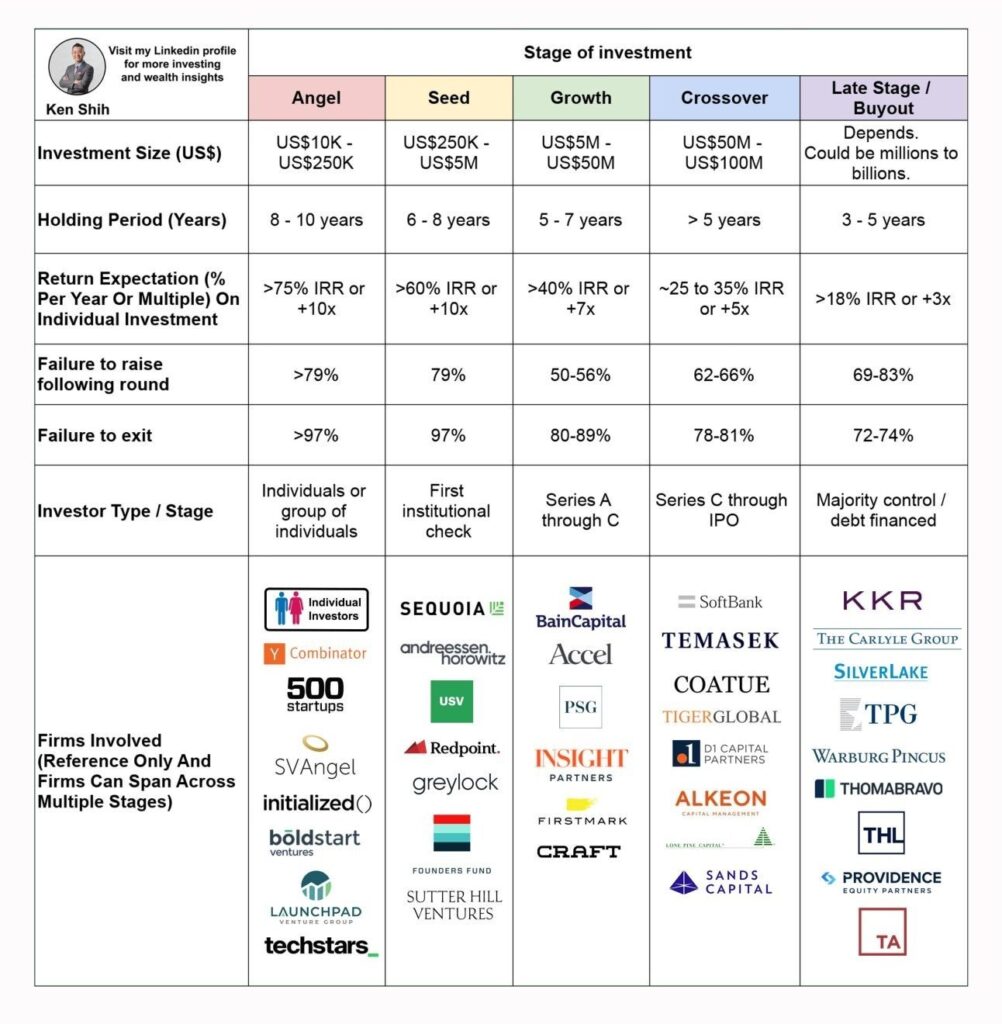
Angel investors and very early-stage funds take on the highest uncertainty, and their return expectations reflect that. They are typically looking for more than 75x IRR or a 10x multiple on individual investments because the failure rates are extremely high, and most of those bets will return nothing. As a company matures, the risk profile changes and so does the type of capital that makes sense.
Growth stage funds typically target 7x returns. Crossover investors, who bridge private and public markets, work with expectations closer to 5x. Late-stage and buyout funds operate with return profiles closer to traditional private equity, often targeting 18% IRR or a 3x multiple.
The reason those multiples step down as the company matures is straightforward: there is more information available at each subsequent stage, which means less uncertainty, which means the investor is taking on a smaller bet and therefore expects a smaller reward. A seed investor is essentially buying a lottery ticket with very high variance. A late-stage investor is buying something much closer to a predictable cash flow business.
This has a direct implication for any founder. When a fund evaluates your company, they are not just assessing the business on its own merits. They are assessing whether your business fits the stage in which that fund is able to deploy capital. A growth fund that looks at an early-stage company is not necessarily passing because the company is bad, they are passing because it is not the right moment for their mandate.
This also explains why there is no single “right” investor for every company. The evaluation criteria, the value-add, and the risk tolerance are genuinely different at each stage. Trying to raise from the wrong type of fund at the wrong moment is one of the most common and avoidable fundraising mistakes founders make.
Will One VC Be with You for the Entire Journey? Almost Certainly Not
This is probably the most idealized expectation that early-stage founders tend to carry. The idea of finding a single fund that will back you from the initial idea all the way to an IPO sounds appealing, but it is structurally difficult for two reasons.
The first reason is about capability. For a single fund to invest meaningfully across all stages, it would need to have deep expertise in early-stage, growth, and late-stage investing simultaneously, with different team profiles for each. That exists at a handful of top-tier global funds like Sequoia or Andreessen Horowitz, but those are the exception. Most funds specialize because specialization is what allows them to add genuine value beyond writing a check.
The second reason is structural. Venture capital funds have a limited lifespan, typically around ten years. A fund that invests in your Seed round in 2024 will likely be in harvesting mode by 2030, looking for exits rather than new commitments. That same fund is unlikely to lead your Series C or D because their own lifecycle does not allow it, regardless of how much they believe in your company.
This means that founders need to think about investor relationships in layers, not as a single long-term partnership. The fund that helps you find product-market fit is probably not the same one that helps you build a sales organization at scale, enter new geographies, or prepare for a public offering. Each type of capital enters when it can add the most value, and that is not a flaw in how the system works. It is by design.
What this means practically is that as a founder you should always be building relationships with the investors who are one or two stages ahead of where you currently are. By the time you actually need that capital, those relationships should already exist. Showing up to a Series B investor for the first time when you are actively trying to raise Series B is already too late.
Closing Thought: Funding Rounds Are a Language, Not Just a Check
Behind every funding round is an agreement between two parties with different levels of information and different risk tolerances, both deciding that the next phase of the journey is worth betting on.
Each round communicates something specific. It says that the previous risk has been reduced enough to justify the next bet. That there is new information about the market, the team, or the product that makes additional capital more likely to generate a return than before.
For a founder, understanding this changes everything about how you prepare for a raise. It is not about having a polished deck or knowing how to tell a good story, although those things matter. It is about being able to show, with real evidence, which specific risk you have eliminated since the last time you asked for capital, and which risk the new money is going to help you reduce next.
The investors who back the best companies are signal readers first and capital allocators second. Each round is a checkpoint in a longer sequence that maps how a team handles uncertainty over time. The evidence you bring to each one tells the story of whether you deserve the next, and that is how funding rounds work in practice.
More from the Startup Fundraising Guide
- Startup Fundraising Guide #1: How to Craft a Winning Pitch Deck for Investors
- Startup Fundraising Guide #2: Tips and Tricks to Nail Your Pitch
- Startup Fundraising Guide #3: Effective Data Rooms for Investor Confidence & Deal Closure
- Startup Fundraising Guide #4: How to Find the Right Investors for Your Startup
- Startup Fundraising Guide #5: Why Investors Say No (and How to Avoid It)