
Data is slowly changing our cultural mindset around healthcare. For a long time, we assumed that consuming healthcare was inevitable once disease appeared. Today, data is showing us a different path, one where long-term preventive solutions outperform short-term reactive treatments. Payers are starting to invest accordingly, gradually reallocating healthcare costs. That shift will not happen overnight, and it won’t come from standalone tools with limited adoption. It will happen through solutions that fit existing workflows and are backed by strong clinical and financial evidence.
This is what makes chronic care costs such an important area of focus. A large share of healthcare spending is still concentrated in chronic conditions, especially among high-risk patients whose needs are not well served by episodic care. The gap between prevention and cost remains one of the clearest structural problems in the healthcare system.
Oska Health is building directly in that gap. Its model combines behavioral science, continuous support, and AI-powered chronic care to identify high-risk patients earlier and intervene before conditions worsen. A purpose that made us participate in its €11M seed round.
The Problem: Why Chronic Care Costs Remain So High
Between 70–80% of healthcare spending is destined to treat chronic patients, but, within that broad category, spending is not distributed evenly. A specific cohort drives a disproportionate share of it: multimorbid patients, particularly those living with overlapping cardiovascular, metabolic, and kidney-related conditions.
These patients often require long-term support, yet most healthcare systems are still organized around isolated appointments. Guidance is delivered during the consultation, but the real challenge begins afterwards, when patients are expected to manage complex conditions in daily life with limited continuous support.
By the time many patients receive more intensive intervention, their conditions have already worsened, making treatment more expensive, more complex, and harder to reverse. Prevention is widely discussed, but it only works when it can be embedded into everyday care.
Why Multimorbid Patient Care Needs a Different Model
Multimorbid patient care cannot be solved with a generic digital health tool. It requires a model that reflects the realities of medical complexity, patient behaviour, physician trust, and payer incentives at the same time.
This is where many digital health companies fall short. The technology may be promising, but if it does not fit the system around it, adoption becomes difficult.
As mentioned in our 2026 VC predictions, if the workflow is not understood, the problem is not understood either. Healthcare is too complex for assumptions, and many digital health companies struggle because they try to impose solutions that do not fit the system.
In healthcare, better outcomes depend not only on innovation, but on whether that innovation works within the existing care chain. This is one of Oska Health’s key strengths.
Oska’s Solution: AI-Powered Chronic Care That Fits the System
Imagine being able to tell insurers that high-risk patients can be identified before they become some of the most expensive cases in the system. Then imagine enrolling those patients into a model that combines behavioral science, AI-enabled coaching, and continuous support before they reach the most acute stages of disease.
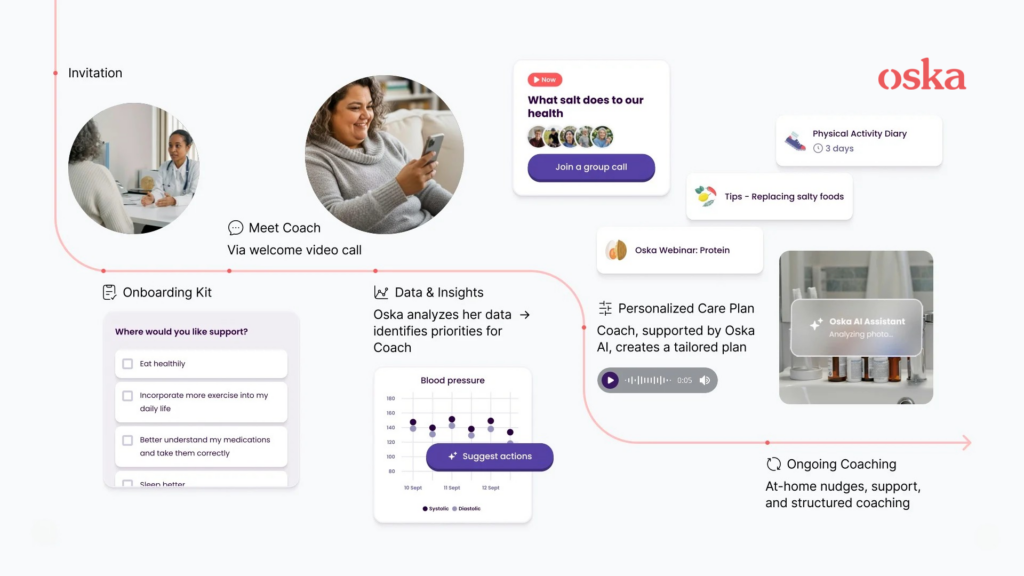
That is precisely the opportunity Oska Health is addressing. The company has built an AI-powered chronic care model designed to activate high-risk patients earlier and support them between doctor visits. Rather than waiting until conditions escalate, Oska aims to improve outcomes through earlier intervention and sustained engagement. This is especially relevant in multimorbid patient care, where daily behaviour and adherence often determine whether prevention succeeds or fails.
Built By a Team with Deep Expertise
Execution ultimately depends on the team behind the company. Founded by Niklas Best, Claudia Ehmke, and Dr. Malte Waldeck, the company brings together leaders who understand both the financial rationale and the patient needs behind chronic care workflows.
- Niklas Best previously led digital innovation initiatives at Fresenius Medical Care, where he gained direct exposure to the structural challenges of managing chronic kidney disease across large healthcare systems.
- Claudia Ehmke brings more than two decades of experience building digital health products, including patient-facing platform development at Fresenius Medical Care and Helios.
- Dr. Malte Waldeck complements the team with strong operational and financial expertise, having helped drive the international expansion of DaVita from €50M to €400M in revenue.
The team understands the incentives across insurers, physicians, and patients, and the product reflects that understanding. Unlike many solutions that struggle with adoption, Oska has built a model where incentives remain aligned across the full care chain.

A Payer-Centred Approach
Insurers will play a major role in the gradual shift toward healthier and more sustainable healthcare systems. Oska has built with that reality in mind from the start.
Instead of launching another digital health product and trying to justify its value afterwards, the company has developed a system around payer demand. It identifies high-risk patients, intervenes earlier, and is designed to reduce chronic care costs without adding friction for physicians or requiring new administrative layers.
This is a meaningful distinction. In healthcare, even strong clinical ideas can fail if they make adoption harder. Oska’s approach is more compelling because it is designed to work with the system rather than around it. Proof of this is Oska’s partnership with more than 20 German statutory health insurance funds.
Lower Friction, Stronger Patient Activation
Another important insight behind Oska’s model is that the GP remains central to patient activation. The doctor-patient relationship is still the strongest trust layer in healthcare. If physicians do not believe in these hybrid care models, patients are far less likely to engage in a meaningful way.
Oska appears to understand this well. Unlike larger competitors such as Oviva or Liva Healthcare in Europe, or Omada in the U.S., Oska does not require a formal prescription. This removes an important bureaucratic friction from the equation.
At the same time, the model still recognizes the doctor’s role in activating and monitoring patients outside the consultation room. That creates the conditions for behavioral change to happen between visits, where chronic care outcomes are often won or lost.
AI Coaching and Behavioral Science Momentum
Beyond the company itself, we also believe the timing is right. Over the past two years, momentum has been building around hybrid care models that combine behavioral science, remote support, and AI-assisted coaching.
Large players are doubling down on this approach. Oviva recently raised a significant round to expand its hybrid care model for chronic diseases. Sword Health acquired Kaia Health to strengthen its position in digital musculoskeletal care. In the U.S., companies like Omada Health and Hinge Health have demonstrated that behaviour-driven care models can scale successfully while generating strong financial outcomes.
The direction is clear: healthcare systems are increasingly looking for scalable ways to improve outcomes before conditions become more severe and more expensive. And Oska is well positioned within that shift.
The company has the potential to become a gateway to a healthier healthcare system. It shows that when strong data is combined with robust predictive risk models, payers are willing to adopt long-term solutions that generate long-term ROI.
When clinical evidence, financial incentives, and scalable care models align, healthcare systems begin to change. That shift could redefine how care is delivered to chronically ill patients.

